
Northern Bangladesh Food Aid Kits & Lotus Ministry Trust's Impact
- Jeffrey Dunan
- 23 hours ago
- 17 min read

Northern Bangladesh faces compounding crises — seasonal flooding, extreme poverty, and limited infrastructure combine to create one of the most persistent food insecurity challenges in South Asia.
Lotus Ministry Trust distributes culturally appropriate food aid kits containing staples like rice and lentils directly to the most vulnerable families — orphans, widows, the elderly, and disabled community members.
Over 100,000 people across rural Bangladesh have received food relief through Lotus Ministry Trust's direct distribution model, which cuts out middlemen to maximize impact.
A small donation goes further than you think — find out exactly how contributions translate into meals on the ground later in this article.
Local volunteers are the backbone of every delivery, bringing community trust and ground-level knowledge that no outside organization can replicate.
Northern Bangladesh Families Are Hungry — Here's What's Being Done
Join Forces With Lotus Ministry Trust
Push The Food Aid Program
Support us directly through the founders' PayPal

Right now, families in northern Bangladesh are skipping meals not because food doesn't exist — but because floods, poverty, and broken supply chains have placed it completely out of reach.
Northern Bangladesh is one of the most flood-prone regions on earth. When the monsoon season hits, entire harvests are submerged, roads become impassable, and rural families — already living on the edge — lose whatever fragile stability they had. What follows is not just hunger. It's a cascading collapse: no food means children can't focus in school, adults can't work, and elderly or disabled family members face genuine survival risk. The problem is cyclical, entrenched, and largely invisible to the outside world.
Lotus Ministry Trust is one of the organizations working directly inside these communities to break that cycle. Rather than operating through layers of contractors and intermediaries, the Trust sends food aid kits directly to verified families in need — prioritizing those with the least access to outside support.
Why Northern Bangladesh Faces Chronic Food Insecurity
The food insecurity in northern Bangladesh is not a new story. It is the product of geography, climate, infrastructure gaps, and deep-rooted poverty colliding year after year in the same communities. The northern river delta regions are among the most climatically exposed areas in the country, experiencing both annual flooding and periods of drought that destabilize agricultural output consistently. To understand more about the impact of these challenges, you can explore the efforts of Lotus Ministry Trust in addressing food insecurity in the region.
What a Food Aid Kit Actually Contains
A Lotus Ministry Trust food aid kit is built around one core principle: give families what they actually eat. In northern Bangladesh, that means rice and lentils — the dietary foundation of nearly every household meal. These aren't generic commodity packages assembled far from the field. They are culturally appropriate, nutrition-conscious essential food packages designed specifically for the families receiving them.
The kits are assembled with local dietary traditions in mind, meaning recipients don't receive unfamiliar or unusable food items that sit unused. Every element of the package serves a direct nutritional purpose for the communities it reaches. This kind of intentional design is what separates effective food aid from well-meaning but poorly targeted relief.
For many recipient families, a single kit represents days of meals — the difference between a week of food security and going without.
Who Lotus Ministry Trust Prioritizes First
Not every vulnerable person has an equal chance of reaching a food distribution point. Lotus Ministry Trust specifically designs its targeting criteria to reach those who face the highest barriers: orphaned children, widows without family income, elderly individuals with no support network, and people living with disabilities. These are the groups most likely to fall through the cracks of larger aid programs that rely on self-registration or community walk-ins.
What Makes Northern Bangladesh a Food Crisis Hotspot
Understanding the scale of the problem means looking past the headlines and into the structural realities that create hunger in this region year after year. Northern Bangladesh sits at the convergence of multiple risk factors that individually would be serious — together, they create a near-permanent state of food vulnerability for millions of people.
The Brahmaputra and Teesta river systems that run through northern Bangladesh are lifelines for agriculture — and annual threats to it. When water levels rise during monsoon season, which happens with near-total predictability, low-lying agricultural land floods rapidly. Smallholder farmers who depend entirely on one or two seasonal harvests can lose everything in a matter of days.
Infrastructure in these rural districts compounds the problem significantly. Unpaved roads that become completely impassable during flooding cut communities off from markets, health services, and food supply chains simultaneously. When outside aid organizations attempt to respond, access itself becomes one of the primary obstacles to delivery.
Annual monsoon flooding regularly submerges agricultural land across northern districts
Unpaved rural roads become impassable during flood season, cutting off food supply chains
Smallholder farmers with no crop insurance lose entire harvests with no financial safety net
Remote villages often sit beyond the reach of government food distribution programs
Chronic poverty means families have no financial reserves to bridge seasonal food gaps
Climate change is intensifying flood severity and extending periods of agricultural disruption
How Seasonal Flooding Wipes Out Harvests Year After Year
The timing of flooding in northern Bangladesh follows a predictable seasonal pattern — which makes it no less devastating. Monsoon rains between June and September cause river levels to surge, and the flat topography of the northern delta means floodwater spreads across vast areas of farmland rapidly. A family that planted rice in May can watch their entire harvest disappear underwater by July.
What makes this cycle so damaging is not just the immediate crop loss — it's the financial aftermath. Farmers in these communities rarely have savings, crop insurance, or alternative income sources. A single failed harvest doesn't just mean one hungry season. It means debt, reduced planting capacity the following year, and a downward spiral that can take years to recover from without direct intervention.
Why Poverty Alone Doesn't Explain the Full Picture
It would be easy to reduce northern Bangladesh's food crisis to a simple poverty narrative — but that framing misses the structural dimensions that make this situation uniquely difficult to address. Poverty is a major factor, but it interacts with geographic isolation, climate vulnerability, and infrastructure gaps in ways that create compounding barriers no single intervention can fully address alone. For instance, the Lotus Ministry Trust's efforts highlight how targeted aid can make a significant difference in addressing these complex challenges.
Many families in these districts are technically land-owning — they farm their own small plots — but land ownership doesn't protect against flooding, crop failure, or the collapse of local markets. A family can own a rice paddy and still face severe food insecurity if that paddy floods three years in a row and there is no support system to help them recover. To learn more about efforts to support these families, visit the Lotus Ministry Trust's initiatives.
This is why food aid programs that also invest in agricultural resilience, community preparedness, and direct household support — the model Lotus Ministry Trust follows — are more effective than emergency-only responses. The crisis is layered, and the response needs to match that complexity.
“Providing food that reflects local dietary traditions helps families receive support that is both practical and respectful. Our goal is to deliver essential food packages that meet immediate nutritional needs while honoring the dignity of every family we serve.”— Lotus Ministry Trust spokesperson
The Groups Most Likely to Go Without Food
When food becomes scarce in northern Bangladesh, the distribution of who goes hungry is not random. It follows a pattern shaped by social vulnerability, physical capacity, and access to support networks. The people who suffer most are almost always those with the fewest options: children who have lost parents, women who have lost husbands, elderly individuals with no working-age family members, and people whose disabilities prevent them from working or traveling to food distribution sites.
Widows in rural Bangladesh face a particularly acute form of food insecurity. In communities where income is typically earned by male heads of household, a woman who loses her husband often loses her family's primary income source simultaneously. Without extended family support — which is itself strained by poverty — these women and their children can face rapid descent into severe hunger.
Children in food-insecure households face consequences that extend far beyond the immediate crisis. Chronic undernourishment during early development affects cognitive function, physical growth, and long-term health outcomes. A child who misses consistent meals during critical developmental years carries the impact of that food insecurity for decades — which is why early intervention through direct food aid programs has consequences well beyond the delivery day itself.
Inside the Lotus Ministry Trust Food Aid Kit
You Can Help Provide The Supply
Support us directly through the founders' PayPal
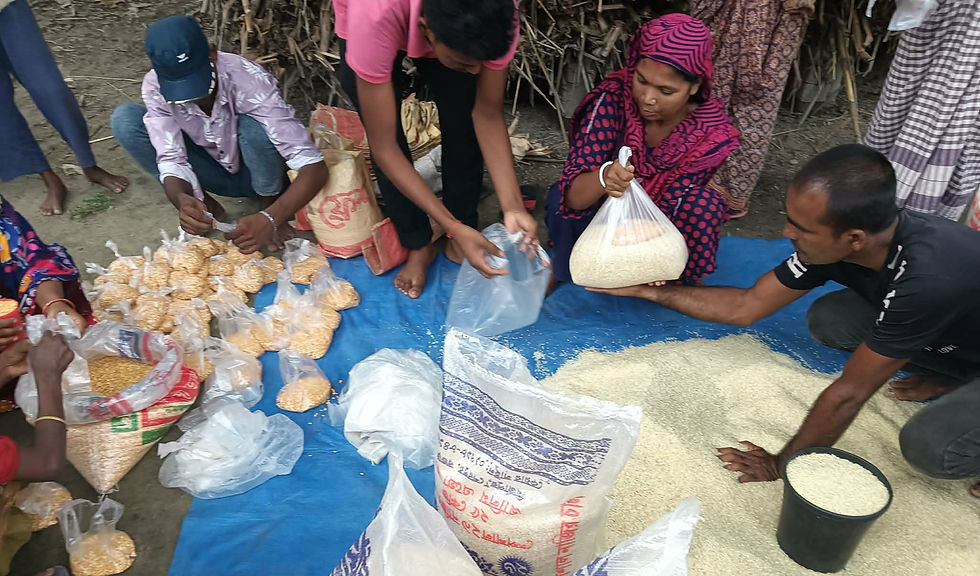
The design of a food aid kit matters more than most people outside humanitarian work realize. Getting food to a remote community is only half the challenge — making sure that food is something families can actually use, prepare, and benefit from nutritionally is equally important. Lotus Ministry Trust has built its kit model specifically around the dietary realities of northern Bangladeshi communities.
Rice is the cornerstone of every kit. In Bangladesh, rice is not simply a food preference — it is the cultural and nutritional foundation of daily life. Pairing rice with lentils creates a nutritionally complementary combination that provides both carbohydrate energy and plant-based protein, addressing two of the most critical nutritional needs in food-insecure households. This isn't accidental — it reflects a deliberate, field-informed approach to what effective food relief actually looks like on the ground in this specific region.
The Trust's expanded food relief program has increased deliveries of these essential packages to underserved rural communities, with a particular focus on reaching families in districts that larger aid operations frequently overlook due to access challenges. Every kit that reaches a family represents not just calories — it represents stability, dignity, and the ability to focus on something other than where the next meal will come from.
Rice and Lentils: The Core of Every Package
Rice and lentils are not chosen arbitrarily — they represent the most nutritionally efficient and culturally resonant combination Lotus Ministry Trust can deliver to northern Bangladeshi families. A kilogram of rice provides sustained caloric energy across multiple meals, while lentils add the protein and iron that food-insecure households, particularly those with young children and pregnant women, critically need. Together, they form a complete dietary foundation that families can prepare with minimal resources.

Your Gift Gives Life To Those The World Has Overlooked
Support us directly through the founders' PayPal
The practicality of this combination also matters enormously in the field. Both rice and lentils have long shelf lives, require only water and basic cooking equipment to prepare, and can stretch across several days of meals when portioned carefully. For a family navigating a post-flood period with limited fuel, no refrigeration, and scarce clean water, these are not small considerations — they are the difference between a useful aid kit and one that creates additional problems.
Why Culturally Appropriate Food Matters in Relief Work
There is a documented pattern in humanitarian aid history of well-intentioned food packages arriving in communities and sitting unused because the contents are unfamiliar, require cooking methods the recipients don't have, or conflict with dietary practices shaped by religion and culture. In Bangladesh, where rice-based meals are central to daily life and dietary identity, delivering food that aligns with existing food culture is not a preference — it is a fundamental condition for the aid to actually work. Lotus Ministry Trust's insistence on culturally appropriate packages reflects a hard-earned understanding of what effective relief actually requires on the ground.
How Lotus Ministry Trust Gets Food to the Right Families
Delivering food aid in northern Bangladesh is a logistical challenge that would overwhelm organizations without deep local knowledge. Flooded roads, remote villages, and the absence of formal address systems in rural areas all create barriers that require local relationships, adaptive planning, and field-level decision-making to overcome. Lotus Ministry Trust has refined its delivery model specifically around these realities, building a system that prioritizes verified need, local accountability, and direct family-level distribution.
Community Assessments Before Any Rice Is Packed
Before a single bag of rice is packed, Lotus Ministry Trust field teams conduct structured community assessments to identify which families qualify for assistance and why. This is not a self-registration process. Teams actively go into communities, speak with local leaders, cross-reference household information, and build verified recipient lists that reflect actual vulnerability rather than proximity to a distribution point. The assessment phase is labor-intensive — but it is what ensures the aid reaches those who need it most rather than those who are simply easiest to reach.
This pre-distribution verification process is what separates targeted relief from generalized food drops. In communities where resources are scarce and competition for aid can be intense, having a verified list based on assessed need — rather than first-come-first-served attendance — protects the most vulnerable recipients, particularly elderly individuals and disabled community members who may not be able to compete in unstructured distribution environments.
Working With Local Leaders to Verify Need
Local community leaders play an integral role in Lotus Ministry Trust's verification process. Village elders, community representatives, and trusted local figures provide on-the-ground intelligence about household circumstances that outside teams cannot easily observe or access independently. This collaboration is not just a courtesy — it is a structural component of the Trust's accuracy in targeting. A local leader who knows which families lost their primary earner, which households include disabled members, and which widows have no extended family support provides information that no external assessment tool can fully replicate.
Why Cutting Out Middlemen Makes Aid More Effective
Every additional layer between a donor and a recipient family introduces the potential for delay, diversion, and reduced impact. Many large aid organizations operate through chains of implementing partners, subcontractors, and local agencies — each layer absorbing administrative costs and introducing coordination complexity. Lotus Ministry Trust's direct distribution model eliminates this chain, ensuring that the maximum possible proportion of every donated dollar reaches the family it was intended for.
Direct delivery also means that the Trust's field teams maintain a real-time understanding of conditions on the ground. When flooding intensifies or access routes change, decisions can be made immediately without waiting for approval through multiple organizational layers. This operational agility is particularly critical in disaster-response contexts where delays of even a few days can have serious humanitarian consequences for families already in crisis.
The Trust's direct model also creates accountability that benefits donors. When a bag of rice is handed to a specific verified family by a known volunteer in a specific community, that transaction is traceable in a way that multi-intermediary distributions are not. This transparency is increasingly important to donors who want confidence that their contributions are translating into real outcomes rather than organizational overhead.
The Role Local Volunteers Play in Every Delivery

Your Compassion Keeps The Forgotten
From Falling Through The Cracks
Support us directly through the founders' PayPal
Local volunteers are not just a logistical resource for Lotus Ministry Trust — they are the connective tissue between the organization and the communities it serves. These are individuals who live in or near the recipient communities, who understand local language and customs, and who carry the trust of the people they are delivering to. That trust is not a soft benefit. It is a practical operational asset that determines whether a distribution goes smoothly or whether vulnerable families — particularly those who are suspicious of outside organizations — actually show up to receive their kits.
Volunteers also provide the ground-level verification that field assessments alone cannot always capture. A volunteer who lives two villages away from a recipient family may know details about that family's circumstances that no formal assessment process would surface — the recently widowed mother, the family that lost their home entirely, the elderly man whose adult children moved to the city and left him without support. This kind of human intelligence shapes distribution decisions in ways that matter enormously to outcomes.
Beyond the practical function they serve, local volunteers represent a model of community-led humanitarian response that has long-term implications beyond any single distribution cycle. When communities are empowered to lead their own relief efforts with support from organizations like Lotus Ministry Trust, they build capacity, relationships, and organizational knowledge that remains after the immediate crisis passes — making those communities more resilient to the next disaster before it arrives.
How Your Donation Translates Into Meals on the Ground
One of the most common barriers to charitable giving is abstraction — the sense that a donation disappears into an organizational budget with no visible connection to the people it was meant to help. Lotus Ministry Trust's direct distribution model exists specifically to close that gap. When you contribute to the Trust's Bangladesh food relief program, the path from donation to delivered rice kit is short, documented, and traceable.
The Trust's GoFundMe campaign for urgent food relief in Bangladesh — accessible at gofundme.com/f/urgent-food-relief-assistance-in-bangladesh — provides a direct channel for contributions that fund the purchase, assembly, and delivery of food aid kits to verified recipient families in northern Bangladesh. Every dollar contributed through this campaign is directed toward field operations, not organizational overhead absorbed before it reaches the ground. To learn more about the impact of Lotus Ministry Trust's efforts in northern Bangladesh, visit their site.
What a Small Contribution Actually Buys
The purchasing power of humanitarian aid contributions in rural Bangladesh is significantly higher than most donors in wealthier countries intuitively expect. Rice and lentils sourced locally cost a fraction of what equivalent quantities would cost in Western markets, meaning that even modest contributions translate into meaningful quantities of food for recipient families. A contribution that might buy a single restaurant meal in a major Western city can provide days of staple food security for a family of four in northern Bangladesh — that gap in purchasing power is one of the strongest arguments for directing charitable giving toward on-the-ground programs in regions like this.
How to Donate Through the Lotus Ministry Trust GoFundMe Campaign
Donating through Lotus Ministry Trust's GoFundMe campaign is straightforward and takes less than two minutes. Navigate to gofundme.com/f/urgent-food-relief-assistance-in-bangladesh, select a contribution amount, and complete the secure payment process. GoFundMe's platform provides transaction confirmation and campaign updates, so you can follow the progress of the broader fundraising effort over time.
One practical advantage of the GoFundMe platform is its transparency features. The campaign page shows total funds raised, recent contributions, and campaign updates from the organizers — giving donors visibility into how the campaign is progressing and how funds are being deployed in the field. For donors who want to stay engaged beyond a single contribution, following the campaign page is one of the simplest ways to track ongoing impact.
Contributions of any size move the campaign forward. There is no minimum donation threshold, and every amount — whether it covers a portion of one kit or funds multiple deliveries — directly increases the number of families Lotus Ministry Trust can reach in northern Bangladesh during the current relief cycle. If you've been on the fence about whether a small contribution makes a real difference, in this context, it genuinely does.
Other Ways to Support Beyond Donating Money
Financial contributions are the most direct form of support, but they're not the only one that matters. Sharing the GoFundMe campaign link through your personal social media channels, email networks, or community groups extends the campaign's reach to potential donors who would contribute if they simply knew the program existed. In crowdfunding campaigns, peer-to-peer sharing consistently drives a significant portion of total donations — meaning your network is itself a form of contribution.
Organizations, faith communities, schools, and workplaces can also engage with Lotus Ministry Trust's work at a group level — whether through coordinated fundraising drives, awareness events, or direct organizational partnerships. For those interested in deeper engagement with the Trust's mission in Bangladesh, reaching out directly at lotus.ministry.trust@gmail.com opens a conversation about how sustained involvement might look beyond a single campaign contribution.
No Relief Network, No Safety Net — That's the Reality for Most Families
The hardest truth about food insecurity in northern Bangladesh is this: for the majority of affected families, there is no backup. There is no government safety net robust enough to reach remote villages during flood season. There is no private insurance to replace a destroyed harvest. There is no extended family with surplus resources to share. When a crisis hits and a family has nothing left, the only thing standing between them and genuine starvation is whether an organization like Lotus Ministry Trust has the resources to reach them in time.
That reality is what makes direct-action food relief programs not just valuable, but essential. The families Lotus Ministry Trust serves are not navigating a temporary inconvenience — they are surviving in conditions where a single missed harvest, a single flood season, or the loss of a primary earner can trigger a food crisis with no self-correcting mechanism. External support is not a supplement to local resilience in these communities. In many cases, it is the only resilience they have. That's worth remembering the next time you consider whether your contribution to a relief campaign actually matters.
Frequently Asked Questions
Below are the most common questions people ask about northern Bangladesh food aid and Lotus Ministry Trust's relief program. Each answer is drawn directly from documented field operations and organizational reporting.
What areas of northern Bangladesh does Lotus Ministry Trust operate in?
Lotus Ministry Trust operates across multiple districts in Bangladesh, with programming concentrated in rural communities that face the highest exposure to seasonal flooding and chronic poverty. The Trust's geographic focus includes northern inland regions as well as coastal communities, prioritizing areas that fall outside the reach of larger aid organizations due to access challenges during flood season.
The Trust's field teams use community-level assessments to identify which villages and households require direct intervention, meaning coverage is guided by verified need rather than fixed district boundaries. This adaptive approach allows the organization to respond to emerging crises in areas that might not receive attention from organizations using more rigid geographic targeting frameworks.
Who qualifies to receive a food aid kit from Lotus Ministry Trust?
Lotus Ministry Trust prioritizes the most structurally vulnerable members of recipient communities: orphaned children, widows without family income support, elderly individuals with no working-age family members, and people living with disabilities that prevent them from working or accessing food distribution independently. These groups are specifically targeted because they face the greatest barriers to receiving support through other channels and are most likely to be overlooked by larger, less targeted programs.
Eligibility is determined through field assessments and community leader verification rather than self-registration. This means families do not need to navigate an application process — the Trust's teams actively identify and verify recipients, which is particularly important for elderly or disabled individuals who may not be physically able to seek out aid on their own.
How does Lotus Ministry Trust ensure donations reach the right families?
Lotus Ministry Trust uses a three-part verification system: pre-distribution community assessments conducted by field teams, cross-referencing with local community leaders who provide household-level knowledge, and direct volunteer-led delivery to named, verified recipients. By cutting out intermediaries and maintaining a direct delivery chain from kit assembly to family doorstep, the Trust minimizes the risk of diversion and ensures that contributions translate into food for the specific families they were intended to reach.
Does Lotus Ministry Trust only provide emergency food relief?
No. While direct food aid is the most visible component of Lotus Ministry Trust's work in Bangladesh, the organization also invests in longer-term community resilience through agricultural training, disaster preparedness programming, and educational support. These complementary programs are designed to address the root causes of food insecurity rather than simply responding to crises after they occur.
This dual-track model — combining immediate relief with longer-term development investment — is what distinguishes Lotus Ministry Trust from purely emergency-response organizations. The goal is not only to feed families during a crisis but to reduce the frequency and severity of crises those same families face in subsequent years. Food aid and community development are treated as complementary, not competing, priorities within the Trust's operational framework.
How can I track the impact of my donation to Lotus Ministry Trust?
Donors can follow the progress of Lotus Ministry Trust's Bangladesh food relief campaign directly through the GoFundMe campaign page, which is updated with fundraising milestones and field reports as distributions occur. For deeper engagement and direct updates from the organization, the Trust can be contacted at lotus.ministry.trust@gmail.com. Additional documentation of the Trust's field work and community impact is available through their website at lotus-ministry.org.
Follow the GoFundMe campaign page for real-time fundraising updates and field reports
Visit lotus-ministry.org for documented program outcomes and community impact reporting
Contact the Trust directly at lotus.ministry.trust@gmail.com for specific distribution updates
Share the campaign with your network to extend reach and increase the number of families the Trust can serve
Follow Lotus Ministry Trust's social channels for field photography, volunteer stories, and distribution updates
The Trust's track record of serving more than 100,000 people across rural Bangladesh provides a documented baseline for understanding the scale of impact that sustained contributions make possible. That figure represents real families in real communities — not an abstract metric.
Ultimately, the most meaningful measure of your donation's impact is not a number on a campaign page. It is a family in a flooded village in northern Bangladesh that eats today because someone halfway around the world decided their hunger was worth responding to. Lotus Ministry Trust exists to make that connection real — and every contribution, regardless of size, is part of making it happen.
Food insecurity in northern Bangladesh is solvable — not completely, not overnight, but meaningfully and measurably, one family and one kit at a time. The infrastructure for effective, targeted, dignified food relief exists. What it needs is sustained support from people who understand that geographic distance is not a reason to look away from preventable suffering.
The families waiting for the next delivery from Lotus Ministry Trust are not statistics. They are parents trying to feed their children, elderly women living alone after losing their husbands, children who have already lost too much. Their hunger is urgent. The response available to them is direct. And your ability to contribute to that response is real and immediate — through the Lotus Ministry Trust GoFundMe campaign or directly through the organization itself.
Lotus Ministry Trust brings verified, community-led food relief directly to northern Bangladesh's most vulnerable families — consider supporting their work today.










Comments