
Bangladesh Rural Food Assistance: Lotus Ministry Initiatives & Programs

Key Takeaways
Lotus Ministry Trust has distributed roughly 1,500,000kg of food assistance to more than 25,000 families since starting operations in Bangladesh
Climate disasters like the 2022 floods destroyed up to 90% of rice crops in some villages, pushing thousands of families into crisis
Women and children carry the heaviest burden, with women often eating 20-30% fewer calories than men during shortages
Over 40 million people across Bangladesh struggle with food insecurity, with rural northern districts facing the most severe conditions
A community-led distribution model and local food sourcing mean donations do more than feed people—they rebuild local economies too
Hunger doesn't wait for a good harvest season, and in rural Bangladesh, it rarely gets the chance to.
Join With Lotus Ministry And Be A Big Part Of The Solution
Support Lotus Ministry Directly Through The Founders' PayPal

Across the country, more than 40 million people wake up each day unsure whether they'll have enough to eat. That number isn't spread evenly—rural communities bear the brunt of it, especially in the north, where flooding, shifting weather patterns, and outdated farming calendars have turned food security into a year-round struggle rather than a seasonal worry. Organizations like Lotus Ministry Trust have stepped into this gap, working directly with rural households to deliver food and rebuild resilience from the ground up.
This article breaks down exactly what's driving food insecurity in Bangladesh's rural districts, who's affected most, and how targeted relief programs are turning small donations into real, measurable change.
Why 40 Million Bangladeshis Are Going Hungry Right Now
Food insecurity in Bangladesh isn't a new crisis, but it's gotten more complicated in recent years. Rural populations face compounding pressures—unpredictable weather, shrinking arable land, and economic shocks that hit farming households hardest. The result is a population where basic nutrition is a daily gamble for tens of millions of people.
The Northern Districts Hit Hardest: Kurigram, Gaibandha, and Jamalpur
Some regions carry a heavier load than others. In Kurigram, Gaibandha, and Jamalpur, over 60% of households can't reliably meet their nutritional needs. These districts sit in flood-prone lowlands where rivers regularly overflow their banks, wiping out crops and displacing families with little warning. Efforts like the Bangladesh Humanitarian Aid Charity aim to provide relief to these affected areas.
How "Monga" Seasonal Hunger Cycles Trap Rural Families
Locals call it "monga"—a seasonal hunger period that hits between planting and harvest, when food stores run low and wages from agricultural labor dry up. It's not a new phenomenon, but climate change has intensified these cycles, stretching lean periods longer and making recovery between them harder to achieve. Organizations like Lotus Ministry Trust are working to provide culturally-appropriate food aid to help alleviate these challenges.
Five "Hundred-Year Floods" in One Decade
Statistically, a "hundred-year flood" should happen once a century. Bangladesh has seen five
of them in the past ten years alone. That kind of frequency doesn't give farming communities time to rebuild before the next disaster hits, which is exactly why chronic food insecurity has become the norm rather than the exception in these areas.
2022 Floods Wiped Out 90% of Rice Crops in Kurigram
The 2022 floods stand out as a turning point. In the village of Kurigram alone, flooding destroyed 90% of rice crops, stripping families of both their food supply and their income source in a single season. Rice isn't just a staple in Bangladesh—it's the backbone of rural livelihoods, so losses at this scale ripple through entire communities.
Recovery from a loss like that doesn't happen overnight. Farmers need seed, capital, and time to replant, and floods often return before any of those three are fully in place.
Rising Temperatures Are Fueling Year-Round Crop Pests
Warmer temperatures have created a second, quieter crisis: pests that used to die off in cooler months now survive and reproduce all year long. This shift has forced farmers to fight infestations they never used to worry about, adding another layer of unpredictability to an already fragile food system. For more information on how organizations are addressing food challenges, check out the Bangladesh Humanitarian Aid Charity.
Pest populations once controlled by seasonal cold snaps now persist through what used to be safe growing windows
Traditional pest management techniques, timed to old weather patterns, are increasingly ineffective
Crop losses from pests compound losses from flooding, leaving less margin for error each growing season
Put together, these pressures mean farmers are fighting a two-front war—against water and against insects—with fewer resources than ever to do it.
5,000 Families Left Needing Immediate Food Assistance After the Floods
When the 2022 floods receded, more than 5,000 families needed immediate food assistance just to get through the following weeks. That kind of sudden, large-scale need is exactly what pushed organizations like Lotus Ministry Trust to expand their distribution efforts in the region.
During the six-month emergency response following the 2022 floods, Lotus Ministry Trust distributed over 150,000kg of rice to affected families across northern Bangladesh.
That volume of aid doesn't happen without infrastructure already in place before disaster strikes. It's one of the reasons long-term, community-rooted programs tend to respond faster and more effectively than short-term relief efforts assembled after the fact.
Who Suffers Most: Women & Children

Help Neglected And Overlooked Villagers
Support Lotus Ministry Directly Through The Founders' PayPal
Food insecurity rarely affects everyone in a household equally. In rural Bangladesh, the burden falls disproportionately on women and children, both of whom face long-term health consequences that outlast any single food shortage.
Understanding who's most vulnerable helps explain why targeted nutrition programs—not just general food assistance and distribution—matter so much in these communities.
Women Eat 20-30% Fewer Calories Than Men in Food-Insecure Homes
During periods of scarcity, women in food-insecure households typically consume 20-30% fewer calories than the men in their families. This isn't a matter of appetite—it's a cultural pattern where women often eat last and least, prioritizing food assistance for working men and children first.
Over time, that gap takes a toll. Chronic undernutrition weakens immune function, reduces energy for daily labor, and creates health complications that compound during pregnancy.
Stunting Affects 40% of Children Under Five in Lotus Ministry Districts
Children pay a particularly steep price for household food insecurity. In districts where Lotus Ministry Trust operates, stunting affects up to 40% of children under five—a marker of chronic malnutrition that impacts physical growth and long-term development.
Stunted children often face weakened immune systems, making them more susceptible to illness
Cognitive development suffers, which shows up later as difficulty concentrating and learning in school
Micronutrient deficiencies in iron, vitamin A, and zinc are widespread among affected children, compounding growth issues
These aren't isolated statistics—they represent a generation of children whose long-term potential is being shaped by what they eat, or don't eat, in their earliest years.
Pregnant and Nursing Mothers Face the Highest Nutritional Risk
Pregnant and lactating mothers sit at the intersection of these two vulnerable groups, facing compounded risk during a period when nutritional needs are at their highest. Malnutrition during pregnancy doesn't just affect the mother—it directly shapes birth outcomes and a child's health trajectory from day one. Organizations like Lotus Ministry are expanding food assistance support to address these critical needs.
This is exactly why food assistance programs that specifically prioritize nutritional support for mothers and young children tend to produce outsized results relative to general food distribution alone.
Inside Lotus Ministry Trust's Six-Year Fight Against Hunger
Since launching its Bangladesh food assistance project in 2020, Lotus Ministry Trust has built a track record that goes beyond good intentions. The numbers tell a story of consistent, scaled-up impact rather than a one-time relief effort. Founded by Jeffrey Dunan, also known as Vasanta das, the organization has grown from an initial response effort into a structured program with dedicated leadership, including a Director of Asian Development, Shohag Chandra Das, overseeing operations across the three hardest-hit northern districts.
25,000 Families and 100,000+ Individuals Reached Since 2020
Over four years, Lotus Ministry Trust has reached more than 25,000 families, translating to over 100,000 individuals fed. That kind of reach doesn't happen through occasional donations—it requires sustained fundraising, reliable supply chains, and trusted relationships with local communities who know exactly where the need is greatest.
1,500,000kg of Food Assistance Distributed Across Northern Bangladesh
Across four years of operation, the Trust has distributed approximately 1,500,000kg of food. To put that in perspective, that's roughly enough rice, lentils, oil, and salt to fill 150 large shipping containers—all of it delivered directly into the hands of families who otherwise would have gone without.
150,000kg of Rice Delivered During the Post-Flood Emergency Response
A significant chunk of that total came during the 2022-2023 emergency response, when the Trust delivered over 150,000kg of rice in just six months following the devastating floods. That surge in distribution reflects how quickly the organization can pivot from steady-state programming to crisis response when disaster hits.
What's Inside Every Lotus Ministry Food Assistance Package
Food assistance only works if it actually meets nutritional needs, not just fills stomachs. That's why Lotus Ministry Trust designs its aid packages around a core set of items chosen specifically for their caloric density, protein content, and micronutrient value.
Each package is built to stretch as far as possible while still covering the nutritional gaps most common in food-insecure households. Rice provides the bulk of calories, lentils supply protein that's otherwise hard to come by, and fortified oil and iodized salt fill in critical vitamin and mineral deficiencies that show up disproportionately in these communities.
It's a simple formula, but one that's been refined over years of on-the-ground distribution experience.
Rice: The 35,000-Calorie Foundation for a Family of Five
A single 10kg bag of rice provides approximately 35,000 calories—enough to sustain a family of five for roughly two weeks. Rice forms the foundation of every relief package the Trust distributes, chosen both for its caloric efficiency and its cultural centrality as a dietary staple across Bangladesh.
Lentils for Protein
Rice alone doesn't cover a family's nutritional needs, which is why lentils go into every package as the primary protein source. Protein deficiency compounds the effects of caloric shortage, particularly in children, so this addition matters more than it might seem at first glance.
Iodized Salt to Fight Cognitive Development Issues
Iodized salt might seem like a minor addition, but iodine deficiency is directly linked to cognitive impairment, especially in children during critical developmental windows. Including it in every package is a small, low-cost intervention that pays off in ways that aren't always visible right away, but matter enormously over a child's lifetime.
How Your Donation Turns Into Food on the Table
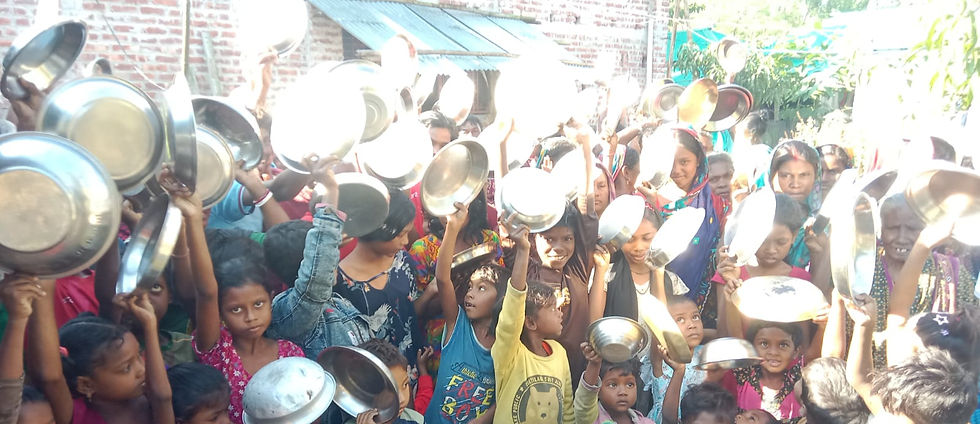
What You Do Matters To Them
Support Lotus Ministry Directly Through The Founders' PayPal
Donors want to know their money actually does something, and Lotus Ministry Trust's donation structure makes that easy to see. Every contribution translates into a specific, measurable amount of food assistance delivered to a specific number of people.
The math is straightforward, and it's one of the reasons the organization's fundraising campaigns have resonated with thousands of individual donors.
$10 Feeds a Family for a Week, $50 Feeds Them for a Month
A $10 donation provides a family of five with essential food items for an entire week. Scale that up to $50, and the same family is covered for a full month. These aren't rounded estimates—they're calculated directly from the cost of the rice, lentils, oil, and salt that make up each distribution package.
For donors trying to decide how much to give, this kind of transparency makes it easy to picture exactly what their contribution accomplishes on the ground. For more information, you can read about the impact of food relief efforts by the Lotus Ministry Trust.
85% of Every Dollar Goes Directly to Food Purchases
Of every $10 donated, approximately $8.50 goes directly toward purchasing food. That 85% allocation rate is high by nonprofit standards, and it reflects a deliberate effort to keep overhead lean so donations translate into maximum on-the-ground impact.
Donors increasingly scrutinize how charitable organizations spend their money, and this level of transparency around fund allocation has become a key differentiator for organizations trying to build long-term donor trust.
Quality control matters just as much as delivery. Spoiled or contaminated food does more harm than good, so a portion of every donation goes toward making sure what arrives at distribution points is safe to eat. For more information on food assistance projects, visit Lotus Ministry's initiative in Bangladesh.
Buying Local: How Food Assistance Boosts Bangladesh's Economy
Food assistance doesn't have to be a one-way transaction where money leaves a community and food arrives from outside it. Lotus Ministry Trust has structured its purchasing model to keep money circulating within the same rural economies it's trying to support, creating a ripple effect that extends well beyond the families who directly receive food.
This approach transforms food assistance from pure charity into a form of local economic investment, one that strengthens the very agricultural systems that food-insecure families depend on long-term.
$175,000 Injected Into Rural Economies in One Program Year
During the 2022-2023 program year alone, local purchasing injected over $175,000 into rural economies across northern Bangladesh. That's money that went directly to local farmers and producers rather than international suppliers, keeping economic benefit concentrated in the communities that need it most.
Every $100 Spent Locally Generates $70 More in Community Activity
Economic research on local purchasing suggests that for every $100 spent on food within a local economy, an estimated $70 of additional economic activity gets generated in the surrounding community. That multiplier effect happens because local farmers, in turn, spend their earnings on other local goods and services, creating a cycle of reinvestment that outside food donations simply don't produce.
300 Farming Households Benefit Beyond Direct Aid Recipients
Local sourcing has supported approximately 300 farming households beyond the families who directly receive food assistance. These are farmers who supply the rice, lentils, and other staples that go into distribution packages, meaning the same program that feeds hungry families also provides steady income to the region's agricultural producers.
Sourcing Within 50km to Cut Fuel Use and Support Nearby Farms
Whenever possible, Lotus Ministry Trust sources food from farmers within 50km of distribution points. This proximity-first approach cuts down on transportation costs and fuel use while ensuring that purchasing dollars stay as close as possible to the communities receiving aid.
It's a model that treats local farmers as partners in the solution, not just outside suppliers—an approach that other food relief organizations have increasingly started to adopt as its economic benefits become clearer.
Community-Led Distribution: Putting Local Leaders in Charge
Effective food assistance depends as much on trust and local knowledge as it does on the food itself. Lotus Ministry Trust has built its distribution model around local leadership rather than top-down decision-making, which has proven critical to reaching the families who need help most.
Partnering With Farmers' Associations, Women's Groups, and Faith Leaders
Local volunteers, drawn from farmers' associations, women's groups, and faith leaders within each community, manage registration, verification, and distribution processes on the ground. These are people who already understand which households are struggling most, which cuts down on both fraud and oversight gaps that can plague aid programs run entirely from the outside.
What's Next: Expanding to 50,000 More People and Beyond
Lotus Ministry Trust isn't slowing down. The organization has announced plans to reach an additional 50,000 people through expanded distribution efforts, building on the infrastructure and community relationships already established over the past four years.
Lotus Ministry Trust's Renewed Call for Donors and Volunteers
Scaling up requires more than good intentions—it requires funding, volunteers, and continued community partnerships. The organization has renewed its call for support as it works to extend its reach further into underserved rural districts where need remains high.
Plans to Bring the Same Model to Sri Lanka
The success of the Bangladesh program has prompted discussion of extending a similar model to Sri Lanka, where comparable food security challenges exist. A joint humanitarian assistance campaign for both Bangladesh and Sri Lanka has already begun raising funds toward this expanded mission.
How You Can Help Fight Food Insecurity in Bangladesh Today
Getting involved doesn't require a large commitment—even small, consistent donations add up to meaningful impact when channeled through an organization with proven distribution systems already in place.
Donate Directly Through Lotus Ministry Trust's Programs
Direct donations to Lotus Ministry Trust go straight into the food purchasing and distribution pipeline described throughout this article, with 85% of every dollar translating into actual food assistance reaching families in need.
Support the GoFundMe Campaign Nearing Its $450,000 Goal
For those who prefer a crowdfunding approach, the Humanitarian Assistance for Bangladesh and Sri Lanka GoFundMe campaign has already drawn support from 6,563 donors, raising $278,519 toward a $450,000 goal. Every additional contribution moves the campaign closer to funding its next phase of expanded relief efforts.
Frequently Asked Questions
How Much of My Donation Actually Buys Food?
Approximately 85% of every donation goes directly toward food purchases, with the remaining 15% covering logistics, quality control, and minimal administrative costs necessary to get food assistance safely to families in need.
Why Are Northern Districts Like Kurigram So Food-Insecure?
Northern districts sit in flood-prone lowlands that experience repeated crop destruction from seasonal flooding, combined with seasonal hunger cycles known as "monga" that strike between planting and harvest periods.
What Makes "Monga" Different From Regular Hunger Seasons?
Monga refers specifically to the seasonal hunger period in northern Bangladesh when food stores run low and agricultural wages dry up simultaneously, creating a predictable but increasingly severe annual crisis that climate change has made worse over time.
How Does Lotus Ministry Trust Choose Which Villages to Help?
The organization relies on local volunteers and community leaders, including farmers' associations and women's groups, to identify households with the greatest need, ensuring aid reaches families who might otherwise be overlooked by outside organizations.
Can Buying Local Food Really Help the Whole Community?
Yes—research shows that every $100 spent on local food purchases generates an estimated $70 in additional community economic activity, meaning food assistance dollars support farmers and local businesses well beyond the families who directly receive food packages. This is similar to how Lotus Ministry's food-assistance project in Bangladesh has positively impacted the local economy.
Rural food security in Bangladesh won't be solved overnight, but organizations like Lotus Ministry Trust are proving that targeted, community-driven relief can make a measurable difference one family at a time. If you're looking for a way to turn a donation into real, trackable impact, consider supporting Lotus Ministry Trust's ongoing work feeding families across Bangladesh's most vulnerable rural districts.






Comments