
Solar Electric Scooter: Jeffrey E. Dunan's Vision for Affordable, Solar-Assisted Transportation

What if your daily commute, shopping trips, and local errands could be handled by a compact electric vehicle that combines solar charging, practical comfort, and low operating costs? A Solar Electric Scooter.
Inventor and designer Jeffrey E. Dunan has spent decades exploring that possibility. His Solar Electric Scooter concept builds on an early solar-powered electric scooter he developed in Southern California in the late 1970s. The proposed vehicle reimagines personal transportation for people who need an economical way to travel relatively short distances.
The concept combines a streamlined body, a single-seat design, an electric drivetrain, and portable solar panels. Its objective is straightforward: provide the convenience of a small personal vehicle while reducing dependence on gasoline and conventional charging infrastructure.
From a Solar-Powered Experiment to a Modern Transportation Concept
Jeffrey E. Dunan's interest in solar-powered transportation began in Culver City, California, nearly five decades ago.
In 1978 and 1979, he developed and drove a solar-assisted electric vehicle throughout the Los Angeles area. Working with a limited budget, he adapted an existing electric moped, constructed a frame, installed a bucket seat, modified the handlebars, and added two solar panels.
The early vehicle attracted public attention. According to Dunan's project history, the Los Angeles Times featured it on the cover of its Metro section in March 1979. The vehicle was also mentioned on the Paul Harvey radio show and featured at the 1979 World Symposium in Pasadena.
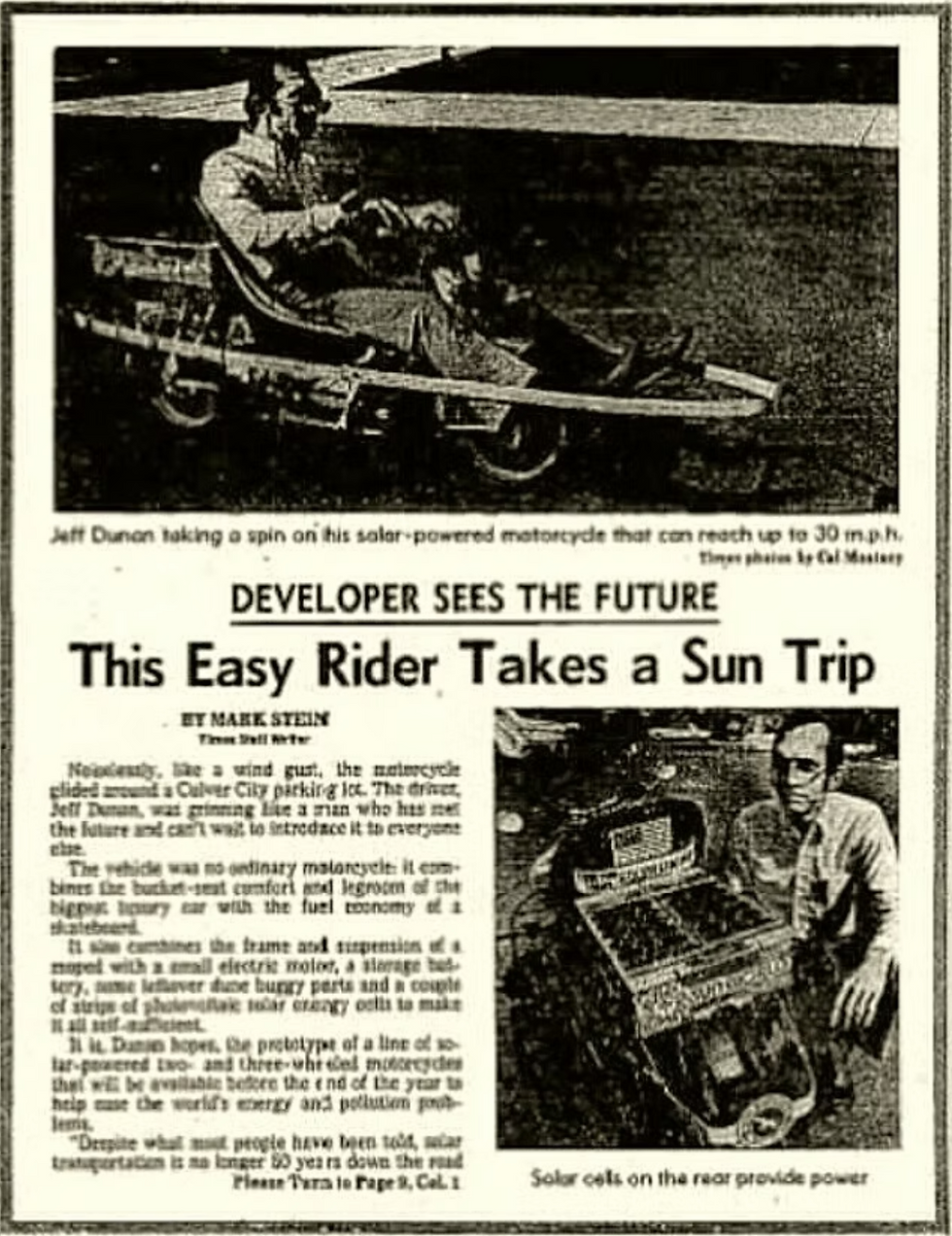
At the time, photovoltaic technology was expensive, and electric vehicles were far less common than they are today. Dunan's early experiment nevertheless established the foundation for a more developed concept: a practical electric vehicle incorporating solar charging.
His later Solar Electric Scooter proposal builds on that experience with a more refined design intended for urban transportation.
A Compact Solar Electric Scooter Designed for Everyday Travel
The Solar Electric Scooter is intended to occupy a space between a conventional electric scooter and a small automobile.
Rather than using the exposed design of a typical scooter, the proposed vehicle would incorporate a streamlined, semi-enclosed body. Dunan describes it as resembling an electric kayak on wheels, with a windshield and a bucket seat.
The design aims to combine the maneuverability of a two-wheeled vehicle with additional comfort and protection for everyday use.
Proposed features include:
A single-seat, two-wheel configuration
An aerodynamic outer shell
A windshield and bucket seat
A carbon-fiber frame
A full roll bar
Seat belts
A digital instrument panel
An adjustable seat and remote-start capability
Electric charging through a conventional power source, supplemented by solar charging
The concept is aimed primarily at urban travel, including commuting, shopping, and other local errands. Its compact dimensions are intended to make it practical for navigating streets and parking in places where a full-sized car may be unnecessary.
The design also contemplates mountain-bike-style tires for possible trail or off-road applications, although urban transportation remains the primary intended use.
Why Short-Distance Transportation Matters
Many everyday trips do not require a large automobile.
Driving to a nearby store, commuting a relatively short distance, visiting a park, or completing local errands can involve transporting just one person. Yet these trips are often made in vehicles designed to carry several passengers.
Dunan's proposal focuses on this gap in the transportation market.
The project document uses an average daily driving distance of approximately 39 miles, calculated from 14,263 miles per year divided by 365 days. This figure provides the basis for considering whether a compact electric vehicle could meet the needs of people whose typical travel is relatively local.
The proposed Solar Electric Scooter is intended for people who want personal mobility without the size and operating demands of a conventional car.
Potential users include college students, young professionals, urban residents, and people who regularly make short trips carrying groceries, a briefcase, or other small items.
The central idea is that a smaller vehicle designed around actual daily travel needs could offer an alternative to using a full-sized automobile for every journey.
Solar Charging: An Additional Source of Energy
One of the concept's defining features is its proposed solar-charging system.
The design includes two portable solar panels rated at 160 watts each, providing a combined rated output of 320 watts. According to the project document, the panels would fold into a compact form for storage and transport.
Each folded panel system is described as measuring approximately 16 by 26 by 1 inches, with a combined weight of about 33 pounds.
Rather than relying exclusively on panels carried on the vehicle while driving, the proposal emphasizes a second-battery arrangement.
Under this approach, the vehicle would operate using one battery pack while the solar panels charged another battery at home or at the office. The charged battery could then be used when needed.
The design also includes conventional plug-in charging as a backup.
This arrangement is intended to provide additional flexibility when access to a power outlet is limited. The project document identifies camping and emergency situations as possible applications.
Actual charging performance would depend on factors such as sunlight, panel orientation, weather, battery capacity, and energy consumption. The proposed solar panels should therefore be understood as a supplementary charging system rather than a guarantee of unlimited driving without external electricity.
Proposed Range, Dimensions, and Operating Costs For Solar Electric Scooters
Dunan's project document outlines preliminary specifications for the scooter-moped version of the Solar Electric Scooter.
The following figures are design targets and estimates from the proposal, not verified production specifications.
Feature | Proposed specification |
Vehicle configuration | Single seat, two wheels |
Estimated range | 50–75 miles |
Initial target weight | Less than 330 pounds |
Maximum width | 32 inches |
Maximum length | 96 inches |
Maximum height | 44 inches, excluding the roll bar and windshield |
Solar charging | Two 160-watt panels |
Estimated direct operating cost | Less than $0.05 per mile |
Proposed retail price | $4,500 or less |

The estimated operating cost excludes financing and insurance. Actual expenses would depend on electricity rates, maintenance, battery replacement, insurance, and other ownership costs.
The proposal also envisions a possible motorcycle version at a later stage, with a target weight of up to 600 pounds.
These specifications illustrate the intended balance between compact dimensions, practical range, and everyday usability. A completed prototype would be needed to establish the vehicle's actual performance, safety, durability, and production costs.
Solar Electric Scooter - An Alternative to More Expensive Electric Vehicles
The project positions the Solar Electric Scooter as an affordable option within the broader electric-vehicle market.
Dunan's 2022 proposal compared the concept with electric bicycles, scooters, mopeds, and higher-priced electric motorcycles. It suggested that a more enclosed, comfortable vehicle priced at $4,500 or less could appeal to people who want more protection and storage than a conventional scooter provides without purchasing a full-sized automobile.
The intended market includes buyers seeking economical personal transportation for relatively short journeys.
Affordability, however, would depend on the cost of developing the prototype, engineering the vehicle for production, validating its safety, sourcing components, and establishing a manufacturing process.
The proposed price is therefore a development target rather than an established retail price.
Safety and Comfort as Design Priorities For Solar Electric Scooters
The Solar Electric Scooter proposal identifies several features intended to distinguish the vehicle from conventional scooters and mopeds.
These include a full roll bar and seat belts, along with the enclosed body concept, windshield, and bucket seat.
Dunan considers the roll bar a particularly important design element. The objective is to combine the compact footprint of a two-wheeled vehicle with safety-oriented features more commonly associated with other types of transportation.
However, the presence of these components does not establish that a vehicle would meet any particular safety standard. Their effectiveness would need to be assessed through engineering analysis, prototype testing, and applicable regulatory review.
For the concept to reach the market, the completed design would need to demonstrate that its structure, restraint systems, stability, braking, visibility, and other safety-related features are suitable for its intended use.
From Prototype to Potential Manufacturing Partnership
The project document identifies prototype development and field testing as essential next steps.
Dunan estimated that approximately $250,000 would be needed to advance the concept. The proposed funding objectives included protecting the design's intellectual property, building and testing a roadworthy prototype, and developing relationships with established electric moped and scooter manufacturers.
The initial development plan focused on Northern California, including San Francisco and surrounding communities. The area was selected in the proposal for its potential to provide a range of real-world street-testing conditions and access to development resources.
The long-term strategy is to license the design to an established manufacturer rather than build an entirely new manufacturing and distribution operation from scratch.
Such a partnership could provide access to existing production facilities, experienced personnel, component suppliers, and marketing capabilities.
The proposal also states that more than 85% of the components needed for assembly were already available. That estimate reflects the inventor's assessment at the time of writing; component availability, compatibility, cost, and suitability would need to be confirmed during development.
The Broader Potential of Solar Electric Scooters
The Solar Electric Scooter represents an approach to transportation that prioritizes efficiency, compact design, and the practical needs of individual travelers.
Its underlying premise is that a vehicle does not need to resemble a conventional automobile to provide useful personal mobility. For many journeys, a smaller electric vehicle with a suitable range, a comfortable seat, secure storage, and flexible charging options may be worth considering.
The solar component adds another dimension by offering a way to supplement conventional charging with renewable energy.
Whether the concept can achieve its proposed price, range, and performance will depend on engineering development, testing, manufacturing economics, and market acceptance. Nevertheless, its design objectives address recognizable challenges in urban transportation: the cost of daily travel, the need for convenient mobility, and the opportunity to use energy more efficiently.
Looking Ahead
Jeffrey E. Dunan's Solar Electric Scooter builds on an early experiment in solar-powered transportation and develops it into a more ambitious personal-vehicle concept.
With its proposed aerodynamic body, single-seat layout, portable solar panels, supplementary plug-in charging, and safety-oriented design features, the project seeks to offer a practical alternative for short-distance travel.
The next steps identified in the proposal are prototype construction, road testing, design protection, and potential licensing to an established manufacturer.
The ultimate test will be whether the completed vehicle can deliver the range, comfort, safety, reliability, and affordability envisioned in the original design.
The vision is simple: make everyday transportation more economical, compact, and energy-conscious by designing a vehicle around the journeys people actually take.
For more information, Contact Jeffrey Dunan by email at lotus.ministry.trust@gmail.com
Source: Jeffrey E. Dunan, “Solar Electric Scooter,” project proposal dated December 1, 2022. Specifications, cost figures, and development plans in this article reflect the proposal and should not be interpreted as confirmation that a production vehicle is available.


Comments