
The Future of Mobility Innovations and Lotus Ministry

Two 160-watt solar panels, a carbon-fiber frame, and a price tag under $3,500 might just be the combination that finally makes electric mobility make sense for everyday riders.
Humanitarian Relief Efforts Need You
Support Lotus Ministry Directly Through The Founders' PayPal

Key Takeaways
The electric two-wheeler market is projected to hit $150 billion by 2030, combining e-bikes, e-scooters, and e-motorcycles into one of the fastest-growing transportation sectors.
Solar-powered scooters now retail between $1,500 and $3,500, with profit margins ranging from 15% to 30% per unit for manufacturers and dealers.
Organizations like Lotus Ministry Trust are proving that mobility innovation and humanitarian aid can work together, channeling a percentage of every scooter sale directly into food and relief efforts overseas.
A single solar scooter can operate for under 5 cents per mile, making it one of the cheapest vehicles to run on American roads today.
Stick around to see how a 1979 garage project in Culver City laid the groundwork for the solar-powered vehicles rolling out in 2025.
Mobility is changing faster than most people realize, and it's not just about swapping gas tanks for batteries anymore. Solar panels, lightweight frames, and smarter supply chains are converging to create vehicles that cost pennies to run and, in some cases, fund humanitarian work on the other side of the planet. This isn't a far-off concept either—prototypes are already rolling off production lines, and the numbers behind them are starting to turn heads across the auto industry.

Why Mobility Innovations Like Electric Two-Wheelers Are Set to Explode by 2030
The electric two-wheeler market isn't creeping toward growth—it's sprinting. Analysts expect the combined value of e-bikes, e-scooters, and e-motorcycles to climb past $150 billion globally by 2030, growing at more than 10% annually through the decade. That kind of momentum doesn't happen by accident. It reflects a shift in how people think about short-distance travel, delivery logistics, and even recreational riding.
Mobility Innovations - E-Bikes, E-Scooters, and E-Motorcycles Combine for $150 Billion in Sales
Break down the numbers and the picture gets even clearer. E-bike sales alone are projected to reach $53 billion by 2030. E-scooters follow close behind at an estimated $39 billion, while e-motorcycles are expected to lead the pack at $58 billion. Together, these three categories represent a transportation shift that's reshaping how Americans get around cities, campuses, and delivery routes.
What's driving this isn't just environmental concern, though that plays a role. Riders are tired of gas price volatility, maintenance headaches, and the sheer cost of owning a traditional vehicle. Electric two-wheelers solve all three problems at once, and manufacturers are racing to meet the demand before competitors corner the market.
North America's Market for Mobility Innovations Jumps From $856 Million to $2.36 Billion
North America, historically slower to adopt electric mobility compared to Europe and Asia, is now catching up fast. The regional market is on pace to grow from roughly $856 million to $2.36 billion within the same decade-long window. That's nearly a threefold increase, and it signals that American consumers are finally warming up to electric alternatives for short commutes and last-mile delivery.
Several factors are fueling this jump:
Rising gas prices have pushed commuters to reconsider how they get to work
College campuses are actively encouraging electric mobility to reduce parking congestion
Delivery companies are adopting electric fleets to cut operating costs
Federal and state incentives are making electric vehicles more affordable upfront
The U.S. Controls Two-Thirds of North American Sales
Within North America, the United States dominates. American buyers account for roughly two-thirds of all regional electric two-wheeler sales, driven largely by urban commuters and young professionals looking for cheaper alternatives to car ownership. This concentration gives U.S.-based manufacturers a built-in advantage, since they can design and test vehicles close to their largest customer base.
Inside the Solar Electric Cycle: A Scooter Powered by the Sun
While battery-only electric scooters dominate headlines, a quieter innovation is gaining traction: solar-assisted mobility. The Solar Electric Cycle represents this shift, combining traditional electric drivetrains with onboard solar panels that extend range and cut charging dependency. It's not a replacement for the grid, but it's a meaningful supplement that changes how often riders need to plug in. Solar powered scooters are quietly becoming one of the more interesting plays for investors who want to maximize returns.
These vehicles aren't experimental toys, either. They're built with practical commuting in mind, targeting the exact distances most Americans drive every day.
50 to 75 Mile Range on a Carbon-Fiber Frame
The scooter-moped version of this design targets a range between 50 and 75 miles per charge, which comfortably covers the average American's daily driving distance of around 39 miles. Keeping the weight under 330 pounds, engineers rely on lightweight materials to maximize efficiency without sacrificing structural integrity. The frame stays compact too, with a max width of 32 inches and a length capped at 96 inches, making it easy to park and maneuver through tight city streets.
Two 160-Watt Solar Panels That Fold Down to 16 x 26 Inches
Each vehicle comes equipped with two 160-watt solar panels, delivering more than 300 watts of total solar power. When folded for storage or transport, these panels shrink down to just 16 by 26 inches and weigh a combined 33 pounds. That portability matters—riders can detach and store the panels when not needed, or keep them mounted for continuous trickle charging throughout the day.
Under 5 Cents Per Mile to Operate
Here's where the economics get genuinely impressive. Estimated direct operating costs come in under 5 cents per mile, a fraction of what gas-powered vehicles cost to run. For context, the average American drives over 14,000 miles annually. At these rates, fuel costs for an entire year could total less than what most drivers spend filling up their tank once a month.
That kind of savings adds up fast, especially for delivery drivers and commuters who put serious mileage on their vehicles week after week. For those interested in alternative transport solutions, solar powered scooters are becoming an intriguing option.
From a 1978 Garage Project to a 2025 Prototype
Your Support Is The Heartbeat Of These Relief Efforts
Support Lotus Ministry Directly Through The Founders' PayPal
Solar mobility isn't a new idea dressed up in modern marketing. It has roots stretching back more than four decades, long before lithium-ion batteries or lightweight solar cells existed in their current form.
The Original Solar Cycle Made Headlines in the LA Times
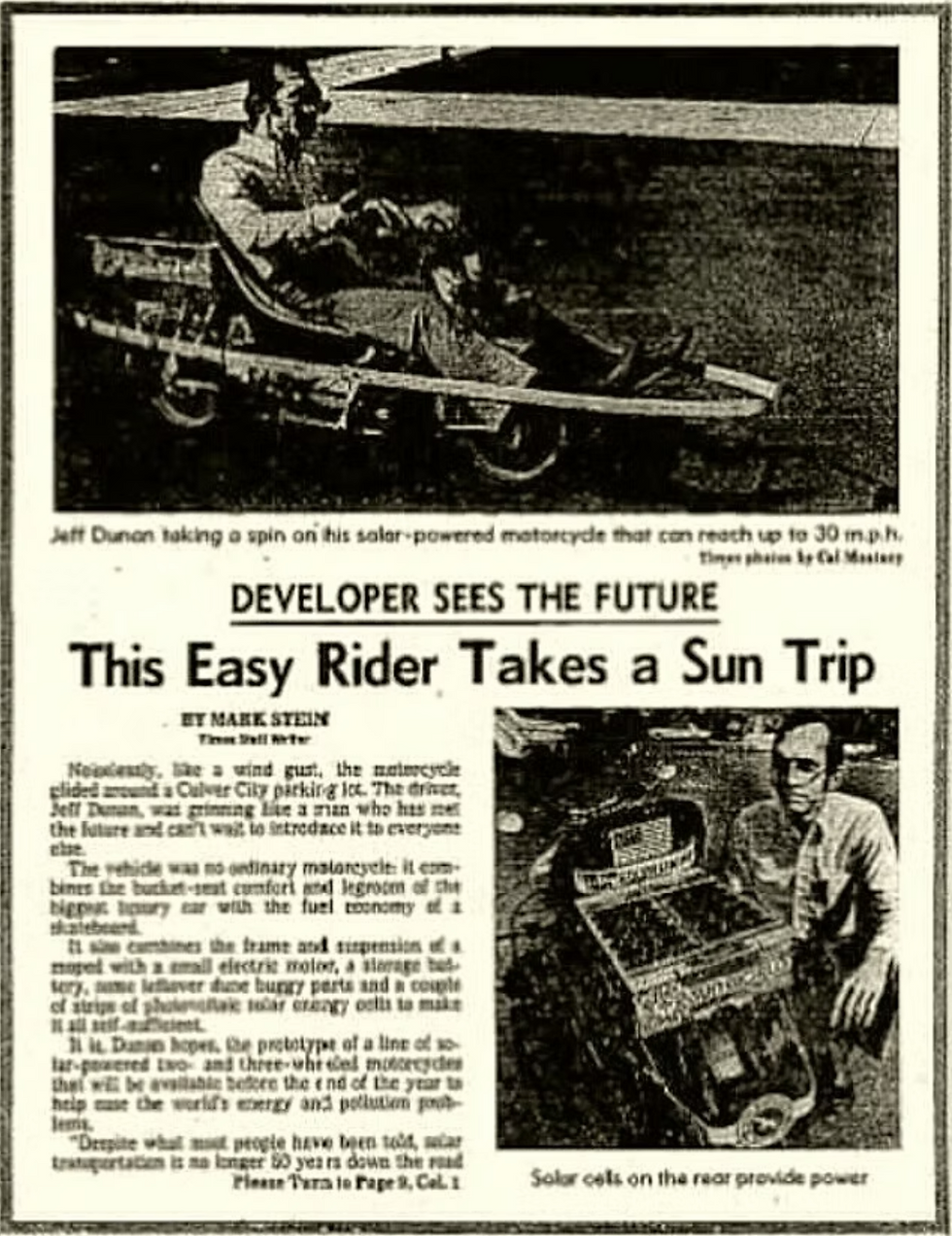
Back in 1979, a solar-powered electric scooter was built and driven in Culver City, California—decades ahead of its time. The vehicle made the cover of the LA Times Metro Section that March, and weeks later, it even got a mention on the nationally syndicated Paul Harvey radio show. The prototype was later featured at the 1979 World Symposium in Pasadena, cementing its place as an early proof of concept for solar-assisted transportation.
At the time, though, the technology simply wasn't ready for mass adoption. Photovoltaic cells cost well over $50 per peak watt, making solar power a luxury reserved for niche experiments rather than practical transportation.
Why Gas Prices Jumping From 50 Cents to $8.35 Changed Everything
In 1979, gas in California cost less than 50 cents per gallon. Fast forward to September 2022, and prices in Los Angeles spiked as high as $8.35 per gallon. That kind of volatility has fundamentally changed how consumers think about transportation costs, pushing many to seriously consider alternatives like solar powered scooters that didn't make financial sense a generation ago.
Consider how the landscape has shifted:
Gas prices in 1979: under 50 cents per gallon
Gas prices in LA by September 2022: up to $8.35 per gallon
Solar panel costs in 1979: over $50 per peak watt
Solar panel costs today: less than $2.50 per peak watt
Solar Panel Costs Dropped From $50 to Under $2.50 Per Watt
This price collapse in solar technology is arguably the single biggest factor making solar-assisted scooters viable today. What once cost a fortune to install now runs a small fraction of that price, opening the door for manufacturers to integrate solar panels into consumer vehicles without pricing out everyday buyers.
What It Actually Costs to Build and Buy These Machines
Numbers tell the real story when it comes to whether a mobility innovation will survive past the prototype stage. For solar-powered scooters, the math is starting to work in favor of both manufacturers and buyers.
Retail Prices Range From $1,500 to $24,000 Depending on the Ride
Solar-powered scooters currently retail between $1,500 and $3,500, depending on specifications and build quality. For comparison, standard e-bikes, e-scooters, and mopeds sell in a similar range of $1,200 to $2,400. On the higher end of the electric mobility spectrum, a Zero brand electric motorcycle lists for $24,000, showing just how wide the price range stretches across this growing category.
Profit Margins Run 15% to 30% Per Unit Sold
Manufacturers and dealers typically see net profit margins between 15% and 30% per unit on solar-powered scooters. That translates to real dollar figures that scale with retail price. A scooter selling at $1,500 with a 15% margin nets $225 in profit. Bump that up to $2,500 at a 22% margin, and profit climbs to $550. At the top end, a $3,500 scooter with a 30% margin delivers $1,050 in profit per unit.
Retail Price | Profit Margin | Profit Per Unit |
$1,500 | 15% | $225 |
$2,500 | 22% | $550 |
$3,500 | 30% | $1,050 |
$250,000 Turns a Concept Into a Road-Worthy Prototype
Building a working prototype from scratch isn't cheap, but it's far more accessible than it used to be. Current estimates put prototype production costs around $250,000—a significant investment, but manageable for small manufacturers and startups compared to the capital required for traditional automotive development. Part of what keeps this cost in check is component availability: more than 85% of the parts needed for assembly are already available on the market, meaning engineers aren't designing every piece from zero.
That existing supply chain infrastructure gives new entrants a genuine shot at competing, rather than requiring decades of R&D before a single unit reaches the road.
The Battery Breakthrough Driving Every Electric Two-Wheeler
None of this progress would matter without the battery technology sitting underneath it. Lithium-ion batteries have quietly transformed what electric two-wheelers are capable of, pushing performance numbers that would have seemed unrealistic just a decade ago.
Lithium-Ion Batteries Hit 90 MPH and 80+ Miles Per Charge
Modern lithium-ion packs now allow electric motorcycles to reach speeds of 90 mph while covering more than 80 miles on a single charge. That combination of speed and range puts electric options on par with many gas-powered motorcycles, minus the fuel stops and oil changes. Riders who once dismissed electric bikes as "around-town only" vehicles are reconsidering, especially as charging infrastructure continues expanding along major commuter routes.
This performance jump matters because it removes the biggest psychological barrier to adoption: range anxiety. When a vehicle can match or exceed what riders expect from traditional engines, the conversation shifts from "can it keep up?" to "why wouldn't I switch?"
Why the Battery Alone Eats Up Half the Vehicle's Cost
Here's the catch, though. Battery packs remain the single most expensive component in any electric two-wheeler, often accounting for roughly half the total manufacturing cost. That's a steep price for a part that, while improving, still requires replacement every few years depending on usage and charging habits.
Manufacturers are working to bring these costs down through better cell chemistry and larger-scale production, but for now, the battery remains both the biggest performance advantage and the biggest line item on the balance sheet.
According to industry cost breakdowns, battery packs typically represent 40% to 50% of total vehicle production expenses—more than the motor, frame, and electronics combined.
That cost structure explains why pricing across the electric two-wheeler market varies so dramatically, from budget-friendly e-scooters under $1,500 to premium electric motorcycles exceeding $20,000.
Small Batteries Still Dominate 85% of 2023 Sales
Despite the appeal of long-range, high-performance options, smaller battery configurations still dominated the market as of 2023, accounting for roughly 85% of total sales. Most consumers simply don't need an 80-mile range for daily commuting, so manufacturers continue producing lighter, cheaper battery packs that match real-world usage patterns rather than maximum theoretical performance.
This trend suggests that affordability, not raw capability, remains the deciding factor for most everyday buyers.
Government Money on the Table for Electric Riders
Buying into electric mobility doesn't have to mean absorbing the full sticker price. Several government incentive programs exist specifically to lower the barrier to entry for riders considering the switch.
These programs stack in interesting ways, and depending on where you live, the combined savings can meaningfully change the math on your purchase.
A 10% Federal Tax Credit Worth Up to $2,500
At the federal level, qualifying electric two-wheelers can earn buyers a tax credit equal to 10% of the purchase price, capped at $2,500. For a $20,000 electric motorcycle, that's a substantial chunk of the purchase price returned come tax season. Even for lower-priced scooters, that 10% credit can meaningfully offset the upfront cost.
Not every vehicle qualifies, though, so it's worth checking current eligibility requirements before assuming a specific model will count toward the credit.
This incentive exists specifically to encourage adoption among everyday consumers, not just commercial fleets or institutional buyers.
California's Clean Vehicle Rebate Project Pays Up to $900
California residents have access to additional state-level incentives through the Clean Vehicle Rebate Project, which can pay out up to $900 for qualifying electric vehicle purchases. Stack that with the federal credit, and California buyers can see combined savings that meaningfully undercut the sticker price of many electric two-wheelers on the market today.
Other states offer similar programs, though incentive amounts and qualifying vehicle types vary significantly depending on local clean energy policy priorities.
The 30% Federal Solar Investment Tax Credit
For riders specifically investing in solar-powered vehicles or solar charging infrastructure, the Federal Solar Investment Tax Credit allows a 30% deduction of installation costs from federal taxes. This credit applies broadly to solar installations, and vehicles that incorporate solar charging components may qualify depending on how the system is structured.
Where These Vehicles Are Actually Being Used
Beyond individual commuters, electric two-wheelers are finding their biggest growth in commercial applications. Fleet operators and institutional buyers are discovering that the math works even better at scale.
Three sectors in particular are driving this commercial shift toward electric adop
tion.
Ride-Sharing Fleets Will Own 80% of Revenue by 2030
Ride-sharing and micromobility fleet operators are projected to account for roughly 80% of total revenue in the electric two-wheeler market by 2030. Companies managing large fleets of e-scooters and e-bikes benefit enormously from lower per-mile operating costs, reduced maintenance compared to gas engines, and simplified fleet management through centralized charging stations.
This dominance by fleet operators also means that individual consumer purchases, while growing, represent a smaller slice of the overall market pie compared to commercial deployment.
Food Delivery Is the Fastest-Growing Use Case
Food delivery has emerged as the fastest-growing commercial application for electric two-wheelers. Delivery companies are increasingly building fleet partnerships around electric scooters and e-bikes, drawn by the combination of lower operating costs and the ability to navigate congested urban streets faster than cars.
For delivery drivers specifically, every cent saved per mile adds up across dozens of daily trips, making the switch to electric an easy financial decision rather than just an environmental one.
College Campuses Are Quietly Becoming a Major Market
Universities across the country are embracing electric mobility programs, partly to reduce parking congestion and partly to cut down on electrical infrastructure demands. Campus mobility programs increasingly favor solar-charging vehicles specifically because they reduce the need for expansive charging station networks, something administrators find attractive given tight facility budgets.
With tens of thousands of college students representing a built-in target market, manufacturers are starting to design vehicles with campus life specifically in mind—lightweight, affordable, and easy to charge without relying entirely on grid electricity.
How One Scooter Purchase Feeds Villages in Bangladesh

Your Donations Keep Hope Alive
Support Lotus Ministry Directly Through The Founders' PayPal
Here's where mobility innovation starts solving problems far beyond transportation. Some manufacturers have built humanitarian impact directly into their business model, turning every vehicle sale into a mechanism for feeding and clothing people in some of the world's most vulnerable communities. Solar powered scooters are quietly becoming one of the more interesting plays for investors who want to make a difference.
Lotus Ministry Trust's Work Across Northern Bangladesh Since 2021
Since 2021, Lotus Ministry Trust has operated field programs across northern Bangladesh, focusing on direct food distribution and basic relief supplies for communities facing chronic food insecurity. Unlike large international NGOs that often operate through multiple layers of bureaucracy, this organization has built a streamlined operation designed for speed and efficiency.
5% to 20% of Every Sale Goes Straight to Food Relief
The profit-sharing model tied to solar-powered scooter sales commits between 5% and 20% of net profit per unit directly to field operations in Bangladesh. That means every scooter purchase isn't just a transportation decision—it's a direct contribution to feeding people living in extreme poverty in Bangladesh.
This model creates a rare alignment between consumer purchasing decisions and tangible humanitarian outcomes, something most product categories simply can't claim.
Why Overhead Costs Stay Low While Big Charities Lose 20-40%
One of the biggest criticisms leveled at large humanitarian organizations involves overhead. Large NGOs typically lose between 20% and 40% of incoming donations to administrative costs before funds ever reach the people they're meant to help. Lotus Ministry Trust's smaller, more direct operational structure avoids much of that bureaucratic drag.
The organization can move from receiving funds to distributing food in a matter of days, not weeks or months. That speed matters enormously in crisis situations where delays can mean the difference between a family eating that week or going without.
Their current goal involves reaching an additional 50,000 people across northern Bangladesh, a target made more achievable through consistent revenue streams tied to product sales rather than relying solely on sporadic donation campaigns.
While large NGOs often lose 20% to 40% of donations to administrative overhead, direct-action organizations like Lotus Ministry Trust can move from fund receipt to food distribution in a matter of days.
A Hot Meal or a Warm Blanket for Less Than a Lunch Out
Perhaps the most striking part of this entire model comes down to simple cost comparison. A full hot vegetarian meal in northern Bangladesh costs a fraction of what the same meal would cost to produce in Western countries. Even more strikingly, a warm blanket—something that can genuinely protect someone during harsh winter nights—costs roughly what an American might spend on a single lunch out.
That cost disparity means a relatively small profit margin from scooter sales can stretch remarkably far when redirected toward direct humanitarian aid, making the entire business model feel less like charity and more like smart, scalable impact investing.
Revenue That Keeps Growing After the Initial Sale
Selling a solar-powered scooter isn't the end of the transaction for manufacturers—it's just the beginning. Smart companies are building recurring revenue streams around the initial purchase, turning one-time buyers into long-term customers.
Replacement Batteries, Panels, and Accessories
Service contracts, replacement batteries, upgraded solar panels, and weatherproof storage covers all represent ongoing revenue opportunities long after the original sale closes. Riders who invest in a solar scooter aren't just buying a vehicle; they're buying into an entire ecosystem of accessories and maintenance options designed to extend the life and performance of their investment.
This aftermarket revenue matters because it smooths out cash flow for manufacturers, who otherwise rely entirely on new unit sales to stay profitable. A customer who returns every year or two for a battery upgrade or replacement panel represents steady, predictable income that doesn't depend on constantly finding new buyers.
Bulk Deals With Delivery Fleets and Universities
Fleet partnerships with delivery companies offer another lucrative revenue channel. These partnerships typically reduce per-mile operating costs for logistics companies while giving manufacturers bulk orders that dwarf individual consumer sales. Multi-year service agreements usually accompany these fleet deals, locking in maintenance and replacement part revenue for years at a stretch.
College campuses represent a similar opportunity. Universities looking to reduce electrical infrastructure costs are drawn specifically to solar-charging vehicles, since they require less investment in charging stations and grid capacity compared to standard battery-electric fleets.
Together, these bulk partnerships create a more stable foundation for manufacturers than relying solely on individual retail sales, which can fluctuate based on consumer spending trends and seasonal demand.
As fleet operators continue to account for the majority of market revenue, moves like this acquisition will likely continue, with larger players absorbing smaller competitors to build scale and efficiency.
Riding Toward a Cleaner, Kinder Future
Mobility innovation has always been about more than just getting from point A to point B faster or cheaper. The solar-powered scooters, lithium-ion motorcycles, and fleet partnerships reshaping transportation today represent something bigger: proof that smart engineering and genuine humanitarian impact can share the same supply chain. Whether you're a commuter chasing lower fuel costs, a fleet manager cutting operating expenses, or simply someone who wants their purchase to mean something beyond convenience, this industry is finally delivering options that check every box.
Frequently Asked Questions
Mobility innovation raises plenty of practical questions, especially for people considering their first electric two-wheeler purchase. Here are answers to the most common ones.
How far can a solar-powered scooter travel on one charge?
Most solar-powered scooter-moped models target a range between 50 and 75 miles per charge. That comfortably covers the average American's daily driving distance of around 39 miles, meaning most riders could go days between full charges depending on their commute.
The onboard solar panels add extra range throughout the day too, especially for riders who park outdoors in direct sunlight during work hours or errands.
Are electric motorcycles more expensive to maintain than gas models?
Generally, no. Electric motorcycles typically cost less to maintain over time since they skip oil changes, exhaust system repairs, and the dozens of moving parts found in traditional combustion engines. The main maintenance expense tends to be eventual battery replacement, which remains the single costliest component of any electric vehicle.
What tax credits can I get for buying an electric scooter in the U.S.?
At the federal level, qualifying electric two-wheelers can earn a tax credit equal to 10% of the purchase price, capped at $2,500. State-level incentives vary, though California's Clean Vehicle Rebate Project offers up to $900 for qualifying vehicles, which can stack with the federal credit for even greater savings.
How does buying a solar scooter help people overseas?
Some manufacturers commit between 5% and 20% of net profit per unit sold directly toward humanitarian aid programs. Lotus Ministry Trust, for example, channels this funding into food distribution and relief efforts across northern Bangladesh, where the organization has operated since 2021 with a goal of reaching an additional 50,000 people.
Is now a good time to invest in electric two-wheeler technology?
Given the market's projected growth to $150 billion by 2030, dropping solar panel costs, and expanding government incentives, timing looks favorable for both consumers and manufacturers entering this space. Early adoption often comes with the steepest learning curve, but it also positions buyers and investors to benefit as infrastructure and technology continue maturing around them.
For more information, Contact Jeffrey Dunan by email at lotus.ministry.trust@gmail.com











Comments