
Lotus Ministry Trust Rice Aid Opportunities & How to Get Involved
- Jeffrey Dunan
- May 20
- 15 min read

Lotus Ministry Trust has delivered food aid to over 100,000 people across rural Bangladesh since launching operations in 2021 — through direct, community-embedded delivery, not intermediary chains.
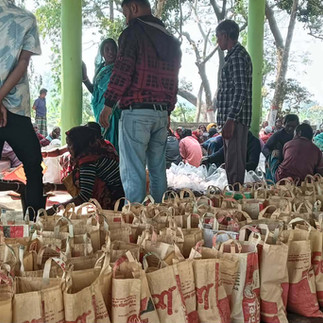
Rice and lentils form the nutritional backbone of every food package distributed, covering both caloric and protein needs for families with no other reliable food source.
Northern Bangladesh faces compounding crises — chronic poverty, seasonal flooding, and geographic isolation — that formal aid systems routinely fail to address at the ground level.
Lotus Ministry Trust prioritizes the most overlooked populations: orphans, widows, the elderly, and disabled community members who fall through the cracks of larger relief programs.
You can directly fund a rice aid delivery through Lotus Ministry Trust's GoFundMe campaign — and later in this article, we break down exactly how your contribution gets from donation to doorstep.
Volunteer And Help Our Volunteers
Support us directly through the founders' PayPal

Right now, families in northern Bangladesh are skipping meals — not because food doesn't exist, but because no one is getting it to them.
That gap between available aid and actual delivery is where most humanitarian efforts collapse. Supply chains stall. Bureaucracy slows distribution. Remote villages get overlooked entirely. Lotus Ministry Trust was built specifically to close that gap — working directly inside rural communities to put rice in the hands of families that larger aid organizations consistently miss.
Northern Bangladesh Families Are Going Hungry Right Now
The hunger crisis in northern Bangladesh isn't a headline emergency — it's a grinding, daily reality that rarely makes international news. Families here face a combination of structural poverty, geographic isolation, and recurring natural disasters that create cycles of food insecurity almost impossible to break without direct, sustained intervention.
Why Northern Bangladesh Faces Chronic Food Insecurity
Northern Bangladesh sits in one of the most flood-prone corridors in South Asia. Each monsoon season, rivers like the Brahmaputra and Teesta overflow, destroying crops, displacing families, and wiping out months of agricultural income in days. The destruction isn't random — it hits the same vulnerable districts repeatedly, preventing communities from ever fully recovering before the next flood season arrives.
Chronic poverty compounds the problem. Many households in these regions survive on subsistence farming, and when harvests fail — whether from flooding, drought, or soil degradation — there is no financial buffer. No savings. No alternative income. Families make impossible choices between feeding children and paying for medicine, or between eating today and preserving seed stock for next season's planting.
Geographic isolation makes all of this worse. Many of the hardest-hit communities are accessible only by boat or on foot during flood season, putting them beyond the reach of standard distribution networks. Formal aid organizations, constrained by logistics and cost, rarely penetrate this deep into rural Bangladesh — leaving entire villages dependent on whatever local resources remain.
Who Lotus Ministry Trust Prioritizes for Rice Aid
Not every vulnerable person in a vulnerable region gets equal access to aid. Within already-struggling communities, certain groups face compounding disadvantages that push them to the absolute margins of food security. Lotus Ministry Trust's distribution model is built around identifying and reaching these individuals first.
The Trust's priority recipients include orphaned children without adult caregivers to advocate for them, widows who have lost their household's primary income earner, elderly individuals who lack the physical capacity to travel to distribution points, and people living with disabilities who are systematically excluded from community-level aid processes. These are the families that even well-meaning local initiatives overlook.
Why Rice Is the Most Critical Form of Relief in This Region
Rice is not simply a food preference in Bangladesh — it is the caloric foundation of the entire diet. For rural families in the north, a day without rice is a day without a real meal. When rice supplies run out, families resort to eating smaller portions of low-nutrition alternatives, which accelerates malnutrition, particularly in young children and the elderly.
Lotus Ministry Trust food packages pair rice with lentils — a deliberate combination that addresses both caloric intake and protein deficiency simultaneously. This pairing reflects a nuanced understanding of rural Bangladeshi nutrition needs that goes well beyond simple calorie delivery.
How Lotus Ministry Trust's Rice Aid Program Actually Works

You Can Help Them
Support us directly through the founders' PayPal
Effective food aid isn't just about having rice — it's about getting the right rice to the right family at the right time. Lotus Ministry Trust's operational model is structured around three core functions: accurate identification of need, reliable last-mile delivery, and community-embedded accountability. Learn more about their food delivery efforts in rural Bangladesh.
This isn't a system built from a headquarters in Dhaka and pushed outward. It's a ground-up network that starts with local knowledge and builds distribution logistics around what the community actually needs and can actually access.
How Vulnerable Families Are Identified Before Distribution
Before a single bag of rice moves, Lotus Ministry Trust's local volunteer network conducts ground-level needs assessments within target communities. Volunteers — who are themselves community members — identify households that meet the Trust's priority criteria: orphaned children, widows, elderly individuals, and people with disabilities who lack alternative food sources.
Lotus Ministry Trust's Identification Criteria for Rice Aid Recipients: ✓ Orphaned children without adult food providers ✓ Widows who have lost their primary household income earner ✓ Elderly individuals unable to travel to distribution points ✓ Disabled community members excluded from standard aid processes ✓ Families in geographically isolated areas with no market access during flood season
This ground-level intelligence is what separates Lotus Ministry Trust from organizations that rely on census data or self-registration systems. Self-registration consistently excludes the most vulnerable — those without the literacy, mobility, or social capital to advocate for themselves.
The volunteer identification model closes that gap. Because volunteers live within the communities they serve, they know which grandmother hasn't eaten in two days and which family just had their rice stores destroyed by flooding. That kind of granular, relational knowledge cannot be replicated by external assessments conducted from outside the community.
This approach also builds community trust. Families are not treated as beneficiaries to be processed — they are known individuals whose specific situations are understood and responded to with dignity. That relational foundation is what makes Lotus Ministry Trust's program sustainable beyond individual distribution events.
How Rice Reaches Remote and Disaster-Affected Communities
Getting rice identified as needed is only half the challenge. The other half is physical delivery to communities that may be accessible only by boat, motorbike, or on foot — particularly during and after flood events when road infrastructure is compromised or entirely submerged.
Local volunteers use boats for distribution across flooded low-lying areas during and after monsoon season.
Motorbikes and manual transport are deployed for communities on elevated terrain or during dry season access.
Distribution points are established within communities rather than requiring families to travel, ensuring the elderly and disabled are not excluded by mobility barriers.
Delivery timing is coordinated around community schedules, agricultural cycles, and disaster event windows to maximize impact.
This logistics model is not accidental — it reflects years of operational learning about what actually works in these environments. Standard distribution point models, where recipients travel to a central location, fail the people Lotus Ministry Trust exists to serve. Bringing the rice to the family, rather than the family to the rice, is a foundational design decision that changes who actually benefits.
During active disaster periods — immediately following major floods or cyclones — Lotus Ministry Trust accelerates its delivery cadence, prioritizing emergency drops to communities that have lost food stores or been cut off from markets. This rapid-response capacity is built into the operational model, not treated as an exception.
How Local Volunteers Strengthen Ground-Level Delivery
The backbone of Lotus Ministry Trust's entire operation is its community-embedded volunteer network. These are not outsiders parachuted in for distribution days — they are local residents with existing relationships, local language fluency, and genuine stakes in their community's wellbeing.
Volunteer involvement does more than reduce logistics costs. It builds a layer of social accountability into the distribution process that external staff simply cannot replicate. When a volunteer from the same village is responsible for ensuring a widow receives her rice allocation, there is a relational obligation that goes beyond organizational policy.
This model also creates capacity within communities that outlasts any single distribution cycle. Volunteers gain organizational skills, logistics experience, and community leadership credibility that strengthen the community's ability to respond to future challenges — whether that's the next flood, the next harvest failure, or the next public health emergency.
Local language fluency eliminates communication barriers that plague external aid deployments.
Pre-existing community trust means families are more likely to accurately report their situation and needs.
Volunteer accountability reduces aid diversion and ensures deliveries reach intended recipients.
Community capacity building creates lasting infrastructure that extends well beyond individual distribution events.
The Real Impact of Rice Aid in Northern Bangladesh
How Many Families the Program Currently Reaches
Since launching in 2021, Lotus Ministry Trust has delivered food aid to over 100,000 people across rural Bangladesh. That figure represents individual human beings reached through direct, face-to-face food delivery — not packages logged in a warehouse system or families registered on a spreadsheet. It is one of the most significant ground-level humanitarian achievements in the region for an organization of its size.
The Trust is currently working toward expanding its reach to an additional 50,000 people across northern Bangladesh. That expansion target is not aspirational language — it is a structured operational goal backed by an existing volunteer network, established distribution routes, and a proven identification model. The limiting factor is not capacity. It is funding. Learn more about the Rice Aid impact in northern Bangladesh and how you can support this initiative.
What Rice Aid Means Beyond a Single Meal
A bag of rice delivered to a widow in northern Bangladesh is not just calories. It is the difference between a child attending school or staying home to manage hunger. It is a mother's ability to focus on planting next season's crop rather than scrambling for daily food.
It is an elderly man retaining his dignity rather than depending on neighbors who are themselves struggling. Rice aid, delivered consistently and reliably, creates stability — and stability is the foundation on which every other form of development becomes possible.
The ripple effects extend further than most donors initially consider. When a family's immediate food need is met, cognitive bandwidth opens up. Parents can make longer-term decisions. Children concentrate in school. Community members participate in agricultural training programs rather than spending every available hour on food acquisition. This is why Lotus Ministry Trust frames its rice aid not as charity, but as the entry point to genuine community resilience.
Lotus Ministry Trust Goes Beyond Rice Distribution
Food aid that addresses only today's hunger without addressing tomorrow's vulnerability is incomplete. Lotus Ministry Trust's model is built on a dual-track approach: immediate relief that keeps families alive right now, paired with longer-term programming that reduces the conditions that made emergency relief necessary in the first place. This combination is what separates the Trust's work from simple food charity.
Agricultural Training for Flood-Resistant Farming
Northern Bangladesh's flooding cycles destroy crops with devastating regularity. Lotus Ministry Trust addresses this directly through agricultural training programs that teach flood-resistant farming techniques — including elevated planting methods, flood-tolerant crop varieties, and post-flood soil recovery practices. Farmers who complete this training are meaningfully better equipped to protect their harvests during future flood seasons, reducing their dependence on emergency rice aid over time.
Nutritional Supplements Paired With Rice Distributions
Rice and lentils address caloric and protein needs — but they don't cover the full spectrum of nutritional requirements, particularly for young children and pregnant women. Lotus Ministry Trust integrates nutritional supplements into select distribution packages, targeting households with children under five and expectant mothers identified during the volunteer needs assessment process.
This targeted supplementation approach reflects a sophisticated understanding of community nutrition. Rather than applying a blanket supplement to every package — which would be logistically complex and cost-prohibitive — the Trust concentrates this resource where the risk of micronutrient deficiency is highest and the long-term consequences of deficiency are most severe.
Livelihood Support to Reduce Long-Term Aid Dependency
Emergency food aid is a bridge, not a destination. Lotus Ministry Trust's livelihood support programs work alongside rice distributions to help families develop income-generating capacity that reduces their need for ongoing external aid. This includes skills training, small-scale enterprise support, and access to resources that allow households to build economic buffers against the next crisis.
The goal is not to phase out aid abruptly, but to build toward a point where families have enough internal resilience to weather moderate shocks — a poor harvest, a family illness, a localized flood — without falling back into acute food insecurity. Every family that reaches that threshold is one fewer family requiring emergency rice distribution in the next disaster season.

Your Support Is Vital
Support us directly through the founders' PayPal
Here Are 5 Ways to Get Involved With Lotus Ministry Trust Today
You don't have to be a large NGO or corporate donor to make a meaningful difference in northern Bangladesh. Lotus Ministry Trust's support model is deliberately designed to accommodate individuals, faith communities, businesses, and organizations of every size — because the scale of need requires a wide coalition of contributors, not just a handful of major funders.
Whether you have five minutes or five thousand dollars, there is a specific, concrete way for you to move rice from a donor's intent to a family's hands. Here are the five most impactful entry points.
1. Donate Directly Through the GoFundMe Campaign
The most immediate way to get rice into the hands of a vulnerable family in northern Bangladesh is a direct financial contribution through Lotus Ministry Trust's GoFundMe campaign. Funds contributed through this platform move directly into active distribution operations — purchasing rice and lentils, covering last-mile delivery costs, and supporting the volunteer network that makes ground-level delivery possible.
The GoFundMe model also provides donors with campaign updates that track how contributions are being deployed. You are not sending money into an opaque organizational budget — you are contributing to a specific, active campaign with documented outcomes and regular reporting from the field.
Even small contributions have tangible, traceable impact. The rice-to-family pipeline at Lotus Ministry Trust is operationally lean by design — the Trust's direct delivery model eliminates the intermediary costs that consume significant portions of donations in larger aid organizations. More of every dollar reaches the rice.
Contribution size: Any amount is meaningful — the operational model ensures high efficiency at all donation levels.
Transparency: Campaign updates document how funds are being deployed across active distribution operations.
Speed: Funds contribute to active, ongoing distributions — not future planning cycles.
Impact specificity: Rice and lentil packages have a defined cost, meaning donors can directly understand the food equivalent of their contribution.
If you are looking for the single most direct line between your donation and a family receiving food, the GoFundMe campaign is it.
2. Sponsor a Family Through Monthly Giving
One-time donations address immediate crises. Monthly giving builds the sustained operational capacity that keeps rice moving to families between disaster events — during the grinding, less-visible periods of chronic food insecurity that don't make headlines but are just as devastating to the families experiencing them.
A recurring monthly contribution allows Lotus Ministry Trust to plan distribution cycles with greater precision, maintain volunteer network activity between emergency periods, and extend coverage to additional families who are currently beyond the program's funded reach. Predictable funding translates directly into predictable food security for the families the Trust serves.
3. Share the Story on Social Media
Funding follows awareness. Lotus Ministry Trust's ability to expand to its 50,000-person growth target depends not just on existing donors giving more, but on new donors finding out that this program exists. Sharing the Trust's story — their mission, their ground-level model, their documented impact — on your personal and professional social networks is a direct contribution to that awareness-building, even if a financial contribution isn't currently possible for you.
4. Volunteer Your Skills in Logistics, Communications, or Fundraising
Financial contributions are not the only currency of meaningful impact. Lotus Ministry Trust's operational growth requires human expertise across a range of disciplines — and if you have professional skills in logistics coordination, communications, digital marketing, grant writing, or fundraising strategy, those skills have direct, deployable value for this program. Remote volunteer contributions are welcomed and actively utilized. Learn more about Lotus Ministry Trust's food delivery efforts in rural Bangladesh.
Consider what the Trust's expansion to 50,000 additional people actually requires: someone needs to coordinate supply chain logistics, someone needs to communicate impact stories that attract new donors, and someone needs to write the grant applications that unlock institutional funding. These are skilled roles that make direct delivery possible, even when they happen thousands of miles from northern Bangladesh.
5. Partner Organizationally as an NGO, Church, or Business
Partnership Entry Points for Organizations: 📌 NGOs & Aid Organizations: Coordinate geographic coverage to eliminate duplication and extend combined reach into underserved districts. 📌 Faith Communities & Churches: Organize congregation-level fundraising campaigns tied directly to specific distribution events with documented outcomes. 📌 Businesses & Corporations: Align CSR budgets with verified, high-efficiency food aid delivery — with impact reporting suitable for stakeholder communications. 📌 Academic & Research Institutions: Partner on impact assessment, nutritional outcome studies, and community resilience measurement. 📌 Media & Content Organizations: Amplify ground-level stories from northern Bangladesh communities to build broader public awareness and donor pipelines.
Organizational partnerships create leverage that individual contributions cannot. When a church congregation runs a dedicated fundraising campaign for Lotus Ministry Trust, it doesn't just raise funds — it educates a community of people about food insecurity in Bangladesh, creating long-term awareness and a pipeline of informed future donors.
For NGOs and existing aid organizations, coordination partnerships with Lotus Ministry Trust can eliminate geographic overlap in relief coverage, allowing both organizations to extend into underserved areas rather than duplicating efforts in the same districts. In environments where resources are perpetually constrained, that kind of coordination multiplies real-world impact without requiring additional funding from either party.
Businesses looking to align corporate social responsibility commitments with high-efficiency, verified aid delivery will find Lotus Ministry Trust's direct delivery model particularly compelling. The Trust's ground-up operational structure means that a significantly higher proportion of corporate contributions reach food delivery compared to larger, multi-layered international aid organizations — a distinction that matters both ethically and for stakeholder reporting purposes.
Your Contribution Puts Rice in the Hands of Families With No Other Option
Every donation, share, volunteer hour, and organizational partnership that flows toward Lotus Ministry Trust translates into a specific, traceable outcome: a family in northern Bangladesh receives rice that they would not have received otherwise. That is not a marketing claim — it is the operational reality of a program built from the ground up around direct, community-embedded delivery to the people formal aid systems consistently leave behind. The gap between available food aid and the families who need it most is real, it is closing, and your involvement is what makes that closing possible. Visit Lotus Ministry Trust to learn more about how they are transforming food aid delivery across rural Bangladesh.
Frequently Asked Questions
The questions below represent the most common points of curiosity from individuals and organizations considering involvement with Lotus Ministry Trust's rice aid program. Each answer reflects the operational realities of a program built for high-efficiency, community-embedded delivery across some of Bangladesh's most challenging geographic environments.
Understanding how the program actually functions — not just what it intends to do — is the foundation of informed giving. Lotus Ministry Trust's model is transparent by design, and these answers reflect that commitment to clarity.
Quick Reference: Lotus Ministry Trust Program Facts 📍 Founded: 2021 📍 People Reached: Over 100,000 across rural Bangladesh 📍 Primary Aid: Rice and lentil packages for caloric and protein coverage 📍 Priority Recipients: Orphans, widows, elderly, and disabled community members 📍 Delivery Model: Community-embedded volunteers, direct to family 📍 Expansion Target: 50,000 additional people in northern Bangladesh 📍 Donation Platform: GoFundMe — active, ongoing campaign
If your question isn't addressed below, Lotus Ministry Trust's Bangladesh food relief page provides additional operational detail and direct contact options for individuals and organizations seeking deeper engagement with the program.
What Areas of Bangladesh Does Lotus Ministry Trust Operate In?
Lotus Ministry Trust operates across multiple districts in Bangladesh, with its strongest operational concentration in northern inland communities and coastal regions most severely affected by natural disasters and chronic poverty. Northern Bangladesh is the current primary focus of the rice aid expansion effort, given the region's combination of recurring flood devastation, geographic isolation, and persistent gaps in formal aid coverage. The Trust's community volunteer network is embedded across both types of environments, with logistics models adapted to each terrain's specific access challenges.
Can International Donors Contribute to the Rice Aid Program?
Yes — international donors can contribute directly through Lotus Ministry Trust's GoFundMe campaign, which accepts contributions from donors worldwide. The platform handles currency conversion, and contributions at any level flow directly into active rice aid distribution operations. International donors receive the same campaign updates and impact reporting as domestic contributors, maintaining full transparency across all geographies.
How Does Lotus Ministry Trust Ensure Donations Reach the Right Families?
Lotus Ministry Trust's accountability model is built into its delivery structure rather than layered on top of it as an afterthought. Community-embedded volunteers — who are themselves residents of the areas they serve — conduct face-to-face needs assessments, identify priority recipients by name and household, and personally deliver rice packages to those specific families. The relational accountability of a volunteer delivering to a neighbor they personally know creates a natural anti-diversion mechanism that formal monitoring systems cannot replicate.
This model means that aid diversion — one of the most significant integrity challenges in large-scale humanitarian programs — is minimized not through surveillance, but through social accountability. The volunteer who identifies a widow as a priority recipient and then personally delivers her rice package has a community-level stake in that delivery happening correctly. That stake is more reliable than any audit system operating from outside the community. To learn more about the food delivery efforts in rural Bangladesh, visit our detailed article.
How Can Organizations Partner With Lotus Ministry Trust on the Ground?
Organizations interested in formal partnership with Lotus Ministry Trust — whether as NGOs seeking geographic coordination, faith communities organizing congregation-level campaigns, or businesses aligning CSR resources with verified aid delivery — should connect directly through Lotus Ministry Trust's Bangladesh food aid page to discuss specific partnership structures suited to the organization's capacity and objectives.
Partnership arrangements are flexible by design. The Trust understands that different types of organizations have different operational constraints, reporting requirements, and engagement timelines. Whether a partnership takes the form of a one-time coordinated campaign or an ongoing operational relationship, the goal is always the same: more rice reaching more families in northern Bangladesh with greater efficiency than either organization could achieve independently.
If your organization is committed to food security outcomes and wants to understand exactly how a partnership would function in practice, Lotus Ministry Trust's rice aid program is a model worth studying — and a partnership worth pursuing.








Comments