
Lotus Ministry's Food Relief Continues Despite Rising Food Prices
- Jeffrey Dunan
- 4 days ago
- 16 min read

Updated: 3 days ago
Food prices in Bangladesh have surged dramatically, pushing thousands of rural families beyond the breaking point of basic nutrition.
Lotus Ministry Trust operates directly in northern Bangladesh's most remote districts, delivering culturally appropriate food aid where international organizations cannot reach.
A single $50 donation provides a family of five with an entire month of essential food supplies.
Climate disasters, particularly the devastating 2022 floods, wiped out crops across northern Bangladesh and triggered a food crisis that persists today.
Families in northern Bangladesh are skipping meals today not because food doesn't exist, but because rising prices have put it completely out of reach.
Help Us Continue Delivering Meals to Those Who Are Waiting
Support Lotus Ministry directly through the Founders' PayPal

The situation on the ground is more urgent than most headlines capture. Lotus Ministry Trust, a faith-based humanitarian organization founded in 2021, has been documenting what's happening in rural villages across northern Bangladesh firsthand. Their ground assessments confirm that in many communities, families have been forced to reduce both the quantity and quality of meals, limiting themselves to a single daily serving of rice with little to no nutritional variety. More than 5,000 families have been identified as in immediate need of food assistance.
This isn't an abstract statistic. These are real people, real children, real mothers rationing every grain.
Real Families in Bangladesh Are Going Hungry Right Now
"Food relief is about more than just providing meals. It's about dignity, cultural sensitivity, and building sustainable solutions that empower communities to thrive over the long term."— Lotus Ministry Trust Spokesperson
Bangladesh has one of the highest rates of food insecurity in South Asia, and the crisis is not evenly distributed. Urban centers have access to markets, government subsidies, and NGO networks. Rural northern Bangladesh has almost none of that. Families in remote villages depend almost entirely on subsistence agriculture and seasonal labor, both of which have been brutally disrupted by inflation, flooding, and economic instability.
When a day laborer's wage stays flat but the price of rice doubles, something has to give. In most cases, it's food. Families begin cutting meals, then cutting portions, then cutting nutritional diversity entirely. Children are fed first when food is scarce, but even then, what they receive is often inadequate for healthy development. Mothers frequently go without eating so their children can have more.
The ripple effects go well beyond hunger. Malnourished children miss school, fall ill more frequently, and face long-term developmental setbacks. Adults weakened by inadequate nutrition become less productive, earning even less and deepening the cycle of poverty that makes food insecurity so difficult to escape.
Why Northern Bangladesh Faces the Worst Food Insecurity
Northern Bangladesh, particularly the districts of Rangpur, Rajshahi, and surrounding areas, has historically been referred to locally as the "Monga zone" — a term describing the seasonal famine conditions that have defined life in this region for generations. While the term has faded from national conversation, the underlying vulnerabilities have not.
The region sits in a geographic and economic blind spot. It is far from Dhaka's resources, isolated by rivers and floodplains, and dependent on agricultural seasons that have become increasingly unpredictable. Infrastructure is limited. Roads that wash out during monsoon season can cut entire communities off from markets for weeks at a time.
Several compounding factors make northern Bangladesh uniquely vulnerable:
Seasonal labor dependency: Most households rely on rice harvests and day labor, meaning income disappears entirely between planting and harvest seasons.
Limited market access: Remote villages cannot benefit from competitive pricing, leaving families at the mercy of local price spikes.
Low land ownership: Many families farm land they do not own, giving them no collateral, no savings buffer, and no safety net when crops fail.
Weak social protection coverage: Government food assistance programs often do not reach the most isolated villages due to logistical and administrative barriers.
High disaster exposure: Proximity to major river systems means flooding is not an occasional disaster but a near-annual reality.
How Climate Change Turned a Food Crisis Into a Catastrophe
Climate Factor | Impact on Northern Bangladesh | Effect on Food Security |
Irregular monsoon patterns | Unpredictable planting and harvest windows | Reduced crop yields and income |
Severe flooding events | Widespread crop destruction and displacement | Immediate food loss and long-term land damage |
Drought conditions | Soil degradation and water scarcity | Failed harvests and livestock loss |
Rising temperatures | Heat stress on rice and vegetable crops | Lower nutritional yield per acre |
Climate change has fundamentally rewritten the agricultural calendar that Bangladeshi farming communities have relied upon for centuries. Monsoon rains that once arrived predictably now come too early, too late, or with catastrophic intensity. Droughts that were once rare have become recurring threats, destroying standing crops and leaving farmland cracked and depleted.
The 2022 flooding events were among the most destructive in recent memory, inundating vast stretches of northern Bangladesh and wiping out crops across entire districts. What followed was not just a short-term food shortage but a sustained collapse of household food security that pushed thousands of already-vulnerable families into crisis.
For communities that had no savings, no insurance, and no government safety net to fall back on, the floods didn't just destroy food. They destroyed the capacity to produce food again next season, creating a cascading emergency that stretched well into 2023 and beyond.
Women and Children Carry the Heaviest Burden
In every food crisis, women and children absorb the sharpest impact. In northern Bangladesh, mothers routinely skip their own meals to ensure children are fed, while girls are more likely than boys to be pulled from school when household resources become critically tight. Acute malnutrition in children under five remains a serious concern in the region, with lasting consequences for cognitive development, immune function, and lifetime earning potential.
What Lotus Ministry Trust Actually Does on the Ground
Lotus Ministry Trust doesn't operate from a distance. Their model is built on direct community presence, local partnerships, and a distribution system designed specifically to navigate Bangladesh's most logistically challenging terrain.
Rice Distribution as the Core of Emergency Relief
Rice is the foundation of Bangladeshi diet, culture, and daily life. Lotus Ministry Trust centers its emergency food aid around rice distribution because it delivers maximum caloric impact per dollar spent while being universally accepted across the communities they serve. Their food aid kits are built around this staple, with each package calculated to meet a family's baseline caloric needs for an extended period without requiring refrigeration or cooking equipment that rural households may not have.
How Culturally Appropriate Food Aid Makes a Difference
One of the most common failures in international food aid is the delivery of food that beneficiaries cannot or will not eat. Unfamiliar grains, foods that conflict with religious dietary practices, or items that require preparation methods unavailable in rural settings all result in wasted resources and unmet needs.
Lotus Ministry Trust avoids this entirely by designing their food packages with deep cultural knowledge. Every kit reflects what Bangladeshi families actually eat, incorporating rice, lentils, and other locally familiar staples that integrate seamlessly into household meals. This approach also ensures that nutritional benefits are actually realized, since families consume the full package rather than trading or discarding unfamiliar items.
Beyond practicality, culturally appropriate aid carries a dignity that generic assistance cannot. When a family receives food that reflects an understanding of who they are, the message is clear: this help was made specifically for them.
Three Northern Districts Where Help Reaches the Unreachable
Lotus Ministry Trust's distribution network focuses on Rangpur and surrounding northern districts, precisely because these are the areas where other organizations struggle to maintain consistent presence. Their established local relationships allow them to reach villages that are inaccessible by standard logistics routes, ensuring that geographic isolation does not determine who receives help and who goes without.
How $50 Feeds a Family of Five for an Entire Month
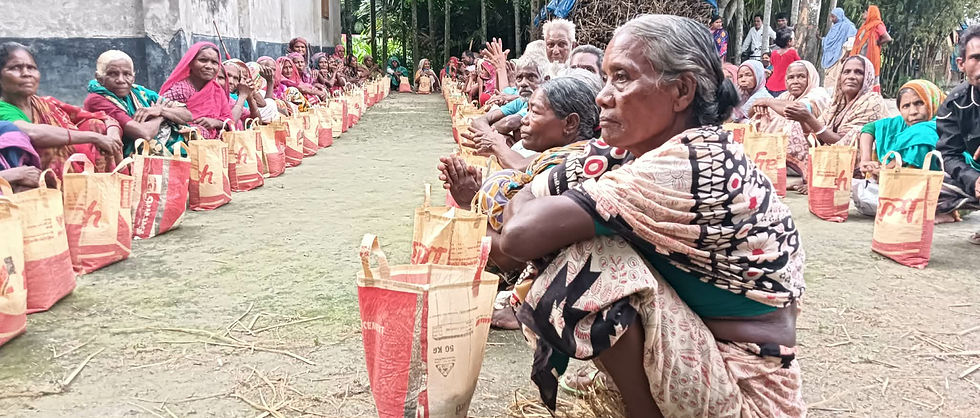
Together, We Can Keep Food Relief
Flowing to Communities in Need
Support Lotus Ministry directly through the Founders' PayPal
The math behind Lotus Ministry Trust's food relief is straightforward and powerful. A single $50 contribution covers the cost of a complete food aid kit designed to sustain a family of five for one full month. That figure includes procurement, packing, and delivery to some of the most remote communities in Bangladesh. Learn more about the impact of Lotus Ministry Trust's efforts in these regions.
This cost efficiency is the result of deliberate operational choices. By sourcing staple foods locally where possible, Lotus Ministry Trust reduces transportation costs while simultaneously supporting local agricultural economies. Their lean organizational structure ensures that donor funds move toward food rather than administrative overhead.
For donors evaluating where their money creates the most impact, few metrics are as clear and direct as this one. Fifty dollars. One family. Thirty days of food security.
What $50 Provides in a Lotus Ministry Trust Food Aid Kit: A full month's supply of rice for a family of five Lentils and supplementary protein sources Culturally familiar staple ingredients Packaged for non-refrigerated rural households Delivered directly to families in remote northern districts
The 2022 Floods Devastated Crops and Sparked a Crisis
The 2022 monsoon season didn't just bring rain to northern Bangladesh — it brought destruction on a scale that erased months of agricultural work in a matter of days. Floodwaters surged through rice paddies, vegetable plots, and homesteads across the region, leaving behind waterlogged soil, ruined harvests, and families with nothing to eat and no immediate way to earn more.
How the Floods Destroyed Northern Bangladesh's Food Supply
When floodwaters recede, the damage they leave behind is far more complex than it appears. Standing crops are lost immediately, but the destruction extends far deeper. Soil that has been submerged for extended periods loses its structure and nutrient content. Seed stocks stored in homes are destroyed. Livestock drown or are displaced. Farmland that took generations to cultivate becomes unworkable for months, sometimes longer.
In northern Bangladesh's most flood-affected districts, entire communities lost both their current food supply and their ability to produce food in the next cycle. Families who had managed to sustain themselves through subsistence farming found themselves with neither harvest nor savings, facing the coming dry season with empty stores and damaged land. The 2022 floods didn't just create a food shortage. They dismantled the fragile systems that communities had built to avoid one.
Lotus Ministry Trust's Emergency Response in Action
When the floods struck, Lotus Ministry Trust activated their existing community networks to identify the most critically affected families and begin distribution as quickly as possible. Because they were already embedded in northern Bangladesh's communities rather than mobilizing from the outside, their response time was significantly faster than organizations that had to establish local contacts from scratch.
Food aid kits reached displaced families during the acute emergency phase, providing immediate caloric support while longer-term recovery planning began. This rapid-response capacity is only possible because of the deep local infrastructure Lotus Ministry Trust had already built before the crisis hit.
Rising Prices Are Making Food Relief Harder to Deliver
Even as the floodwaters receded, a second crisis was quietly accelerating. Global inflation, triggered by supply chain disruptions and compounded by regional economic pressures, began driving food prices upward across Bangladesh at a rate that outpaced income growth for the country's poorest households. What a family could afford to eat in 2021 became financially out of reach by late 2022 and into 2023.
The price of rice — Bangladesh's most essential staple — rose sharply. Lentils, cooking oil, and vegetables followed. For families already operating with zero financial margin, even a 20% price increase on basic groceries meant the difference between one meal a day and none. The crisis stopped being about flood recovery and became something more persistent and structurally embedded: a cost-of-living emergency with no clear end date.
For organizations delivering food relief, rising prices create a compounding problem. The same donation that funded a month of food aid in 2021 covers significantly less in 2024. Procurement costs rise, logistics costs rise, and the number of families requiring assistance grows simultaneously. Relief organizations are being asked to do more with effectively less, at exactly the moment when demand for their services is at its highest.
How Rising Prices Impact Food Relief Operations: Procurement costs increase: The same budget buys fewer kilograms of rice, lentils, and cooking oil than it did two years ago. More families qualify for aid: As prices rise, households that previously managed independently fall below the threshold of food security. Donor purchasing power shrinks: A $50 donation that once covered a full month's kit may now cover only three weeks of supplies. Logistics costs escalate: Fuel prices directly affect the cost of transporting food aid to remote northern districts. Local market instability: Price volatility makes procurement planning difficult, forcing organizations to make purchasing decisions under uncertainty.
How Global Inflation Squeezes Every Dollar of Aid
The inflationary pressure hitting Bangladesh's food markets is not a local phenomenon. It is the downstream effect of global supply chain disruptions, currency fluctuations, and commodity price shocks that ripple from international markets into rural village economies. When wheat prices spike globally, it affects the cost of every alternative grain. When fuel prices rise, transportation costs follow, and those costs are passed directly onto food prices at every point in the supply chain.
Lotus Ministry Trust navigates this by prioritizing local food sourcing wherever possible, reducing exposure to international commodity price swings while keeping procurement costs lower than import-dependent alternatives. But even local markets are not insulated from broader inflation. The pressure is real, measurable, and ongoing, which is precisely why sustained donor support matters more now than it did three years ago.
Infrastructure and Logistics Challenges in Rural Bangladesh
Reaching the families who need food relief most is not simply a matter of having enough supplies. In northern Bangladesh, the final mile of delivery is often the most expensive and the most logistically demanding. Roads that are functional in the dry season become impassable during monsoon months. River crossings that are routine for local residents present significant challenges for loaded vehicles carrying bulk food supplies. Communities that appear reachable on a map may require hours of travel on unpaved tracks, dramatically increasing the per-family cost of delivery. Lotus Ministry Trust's local knowledge and established community relationships are what make consistent delivery to these areas operationally possible.
From Emergency Aid to Long-Term Food Security
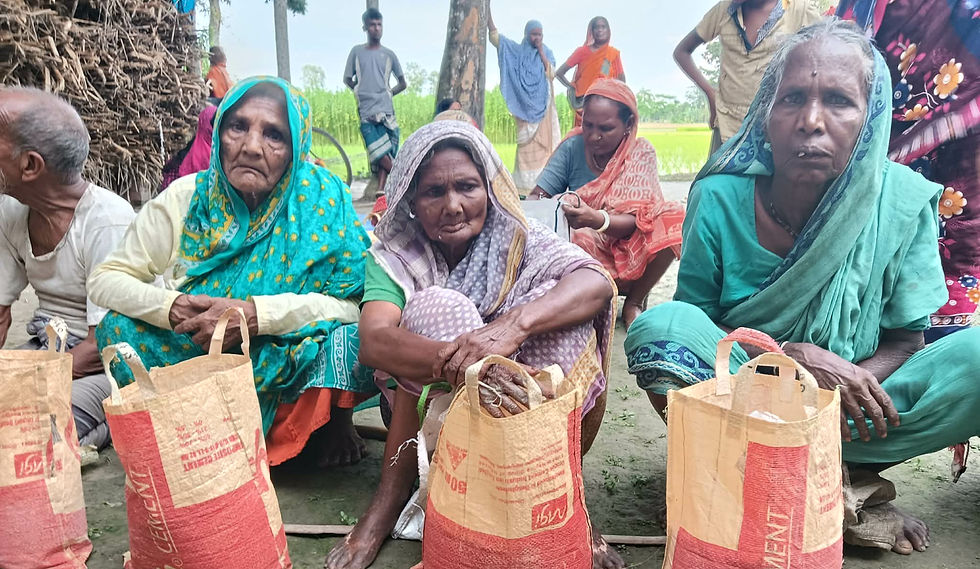
Your Support Helps Keep Food
Reaching the Families Who Need It
Support Lotus Ministry directly through the Founders' PayPal
Emergency food distribution stops hunger today, but it doesn't prevent hunger tomorrow. Lotus Ministry Trust's approach is built on the understanding that relief and development are not separate programs but sequential phases of the same commitment to a community's wellbeing. Their model moves families through three distinct stages, each designed to build on the last.
Phase 1: Immediate Relief That Stops the Crisis
The first phase is exactly what it sounds like: getting food into the hands of families who are actively going without. Speed matters here. A family that skips meals for a week faces health consequences that compound quickly, particularly for children and elderly members. Lotus Ministry Trust's pre-positioned community networks allow them to begin distribution within days of an identified crisis rather than weeks, which is the difference that matters most in the acute emergency stage.
During Phase 1, each family receives a complete food aid kit containing rice, lentils, and culturally appropriate staples calculated to meet their nutritional baseline for 30 days. The delivery is direct and dignified. Families are not required to travel to central distribution points that may be inaccessible — Lotus Ministry Trust brings the aid to where families actually are, including the most remote and flood-isolated villages in their service area.
Phase 2: Agricultural Recovery and Seed Distribution
Once immediate survival needs are stabilized, Phase 2 begins the work of rebuilding a household's capacity to feed itself. This includes seed distribution for the next planting cycle, support for families to restore damaged farmland, and in some cases, assistance replacing lost livestock or farming tools. The goal of Phase 2 is not to create ongoing dependency on food aid but to restore the agricultural foundation that allows a family to become self-sufficient again. Every resource invested in Phase 2 reduces the likelihood that a family will require emergency relief in the next season, making it both a humanitarian and an economic investment in the community's future.
Phase 3: Building Climate-Resilient Communities
The third phase is where emergency relief becomes lasting transformation. Building climate-resilient communities means equipping families and villages with the knowledge, tools, and systems to withstand future disasters without falling back into acute food insecurity. This includes training in flood-resistant crop varieties, water management techniques adapted to northern Bangladesh's river-heavy geography, and community-level early warning systems that give families more lead time before seasonal flooding strikes.
Phase 3 also addresses the social infrastructure that determines how well a community absorbs shocks. Women's agricultural knowledge groups, community food storage cooperatives, and local leadership training all contribute to a village's collective capacity to manage food security independently. When these systems are in place, a single bad harvest or a seasonal flood no longer automatically triggers a humanitarian crisis. The community has the tools to respond before outside help is even needed. Learn more about the impact of these initiatives in Bangladesh Food Relief.
65% of Families Achieve Stable Food Security Within 18 Months
The three-phase model produces measurable outcomes. Lotus Ministry Trust's ground assessments indicate that 65% of families who receive support through all three phases achieve stable, self-sustaining food security within 18 months of initial engagement. That figure represents not just relief but genuine, lasting change in the trajectory of a household's future.
The remaining 35% continue receiving support, with most facing compounding challenges such as chronic illness, extreme isolation, or repeated flood exposure that require extended assistance. Importantly, even these families show meaningful improvement in nutritional outcomes and economic stability compared to households that received emergency aid alone, demonstrating that the phased model adds value at every stage of implementation.
Lotus Ministry Trust Three-Phase Outcome Summary:
Phase | Focus | Timeline | Key Outcome |
Phase 1 | Emergency food distribution | Days to weeks | Immediate hunger crisis halted |
Phase 2 | Agricultural recovery & seeds | 1 to 6 months | Household food production restored |
Phase 3 | Climate resilience building | 6 to 18 months | 65% achieve stable food security |
What this model proves is that emergency food relief, when paired with structured recovery and resilience programming, is not just a short-term intervention. It is an investment with a measurable return in human stability, community strength, and long-term reduction in humanitarian need.
Hope Is Being Restored One Family at a Time
Behind every food aid kit delivered in northern Bangladesh is a family that now has enough to eat today and a real chance at feeding themselves tomorrow. The work Lotus Ministry Trust is doing is not headline-grabbing. It is quiet, consistent, and profoundly human. A mother who no longer has to choose which child eats. A farmer who has seeds for the next planting season. A child who goes to school with a full stomach. These are the moments that define what food relief actually means when it reaches the right hands. If you are ready to be part of that, support Lotus Ministry Trust's food relief efforts in Bangladesh here.
Frequently Asked Questions
The following questions address what donors and supporters most commonly want to understand before contributing to food relief efforts in Bangladesh.
How does Lotus Ministry Trust decide which communities receive food relief first?
Lotus Ministry Trust uses a needs-based prioritization system informed by direct community assessments conducted by their local teams in northern Bangladesh. Families are evaluated based on the severity of food insecurity, the presence of vulnerable members such as young children, pregnant women, elderly individuals, and those with chronic illness, as well as geographic isolation that limits their access to other forms of assistance. Communities that have experienced acute crisis triggers such as flood displacement or complete harvest failure are elevated in priority, with distribution beginning within days of identification wherever logistically possible.
Is Lotus Ministry Trust a tax-exempt charitable organization?
Lotus Ministry Trust is a registered faith-based humanitarian organization operating food relief programs in Bangladesh. Donors who wish to confirm the specific tax status and applicable deductibility of their contributions based on their country of residence should consult directly with Lotus Ministry Trust or review their official registration documentation before making a contribution.
For U.S.-based donors, contributions made through the organization's GoFundMe campaign at this link should be evaluated in terms of GoFundMe's own charitable giving policies, as tax deductibility can depend on whether the campaign is registered under GoFundMe Charity or as an individual campaign.
Regardless of tax status, the humanitarian impact of every contribution is direct and verifiable. Donors receive updates on how their funds are being deployed, and Lotus Ministry Trust maintains transparency about where resources go and which communities they serve.
The most important thing for prospective donors to understand is that the need is real, urgent, and ongoing. Whether a contribution is tax-deductible in a given jurisdiction does not change the fact that $50 feeds a family for a month in one of the most food-insecure regions of South Asia.
How does Lotus Ministry Trust ensure food aid is culturally appropriate for Bangladeshi families?
Lotus Ministry Trust designs every food aid kit using firsthand knowledge of Bangladeshi dietary practices, religious considerations, and locally available staple foods. Their team includes local community members and partner organizations who understand exactly what northern Bangladeshi families cook, eat, and depend on as daily nutritional staples. Rice forms the foundation of every kit because it is both the dietary cornerstone of Bangladeshi cuisine and the most universally accepted food across the communities they serve. Supplementary items such as lentils, cooking oil, and other familiar ingredients are included to ensure balanced nutrition without introducing unfamiliar foods that families may not prepare or consume. This is not a generic food parcel — it is a package built around the real lives of the people receiving it.
What percentage of donations go directly to food relief efforts?
Lotus Ministry Trust operates with a lean organizational model specifically designed to maximize the proportion of donor funds that reach families in the form of food. Their local-first operational structure eliminates many of the overhead costs associated with international organizations that manage programs from distant headquarters with large administrative teams.
Local sourcing of food staples where possible reduces both procurement costs and the logistical expenses associated with importing goods from outside Bangladesh. Community-embedded distribution teams, who are members of the areas they serve, further reduce the cost of the final mile of delivery compared to organizations that mobilize external staff for each distribution event.
Donors who want specific figures on operational cost allocation are encouraged to contact Lotus Ministry Trust directly through their official channels, as transparency about fund usage is a core part of how they build and maintain donor trust.
Local food sourcing: Reduces procurement costs and supports regional agricultural economies simultaneously.
Community-embedded teams: Eliminates the overhead of mobilizing external staff for distribution events.
Lean headquarters structure: Minimizes administrative costs so more of every dollar moves toward food.
Direct family distribution: No intermediary organizations taking a share of resources before aid reaches recipients.
Pre-positioned networks: Reduces emergency response costs by eliminating the need to establish infrastructure during a crisis.
The clearest indicator of cost efficiency remains the $50-per-family-per-month figure that Lotus Ministry Trust has consistently maintained. That number includes all costs from procurement through delivery, making it one of the most straightforward impact metrics available to donors evaluating where to direct their charitable giving.
How can someone outside Bangladesh support Lotus Ministry Trust's food relief programs?
Supporting Lotus Ministry Trust from anywhere in the world is straightforward. The most direct path is a financial contribution through their GoFundMe campaign, where donations of any size translate immediately into food aid for families in northern Bangladesh. The $50 benchmark is meaningful but not a minimum — smaller contributions combine with others to fund complete kits, and larger gifts can cover multiple families simultaneously.
Beyond direct donation, one of the most impactful things a supporter outside Bangladesh can do is share information about the crisis and Lotus Ministry Trust's work within their own networks. Awareness drives donations, and in humanitarian contexts, every additional donor reached represents another family that can be served. Social sharing, word-of-mouth, and community fundraising on behalf of Lotus Ministry Trust all multiply the impact of individual support.
For those interested in deeper engagement, Lotus Ministry Trust's website at lotus-ministry.org provides detailed information about their programs, impact reporting, and how ongoing partnerships with international supporters are structured. Whether your contribution is financial, social, or both, it connects directly to a real family in northern Bangladesh whose next meal may depend on it. Lotus Ministry Trust exists to bridge the distance between people who want to help and communities that urgently need it — and that bridge is open to anyone willing to cross it.






Comments