
Lotus Ministry Trust Navigates Culture & Needs Strategies

Article At A Glance: How Lotus Ministry Trust Puts Culture First
Cultural respect isn't optional in humanitarian aid — it's the difference between programs that communities accept and those they reject outright.
Lotus Ministry Trust embeds local Bangladeshi customs, food traditions, and religious sensitivities directly into their food relief and community development strategies.
Bangladesh is one of the world's most culturally layered nations, with Muslim, Hindu, Christian, and Buddhist communities each requiring distinct approaches to aid delivery.
Partner selection at Lotus Ministry Trust goes beyond logistics — cultural knowledge and community trust are non-negotiable criteria.
One strategy in particular has dramatically improved community participation rates — and it has nothing to do with the food itself. Keep reading to find out what it is.
Help Us Keep Hitting The Mark
Support us directly through the founders' PayPal

Getting humanitarian aid right in Bangladesh isn't just about resources — it's about reading the room on a cultural level that most outside organizations completely miss.
Lotus Ministry Trust has spent years building an approach to aid delivery in Bangladesh that treats cultural respect not as a courtesy, but as core strategy. Their work across northern Bangladesh offers one of the clearest real-world examples of what happens when an organization genuinely listens before it acts. This article breaks down the specific strategies they use — and why those strategies produce results that generic aid programs simply can't match.
Bangladesh's Cultural Landscape and Why It Matters for Aid
Bangladesh is not a monolithic culture. While the majority of the population identifies as Muslim — roughly 91% — the country also has significant Hindu, Christian, and Buddhist communities, each with distinct dietary practices, religious observances, and social structures. Treating Bangladesh as culturally uniform is one of the most common and costly mistakes outside organizations make.
Religious Diversity Across Muslim, Hindu, Christian, and Buddhist Communities
Muslim communities observe halal dietary guidelines and hold Friday Jumu'ah prayers as a community anchor point. Hindu communities in Bangladesh, concentrated in districts like Sylhet and Khulna, maintain vegetarian practices and observe festivals like Durga Puja and Saraswati Puja. Smaller Christian communities, many of whom are Bengali converts, observe Christmas and Easter with deeply local cultural expression. Buddhist communities, particularly among the Chakma and Marma peoples of the Chittagong Hill Tracts, follow entirely different social customs around food, gender interaction, and community leadership.
Any humanitarian strategy that fails to account for these distinctions risks distributing food that communities won't eat, scheduling programs during religious observances, or unintentionally disrespecting community leaders — all of which undermine trust instantly and sometimes permanently.
How Village-Based Communal Problem-Solving Shapes Aid Delivery
Bangladeshi villages operate on a deeply communal model. Decisions — even personal ones — are often made collectively, with village elders, religious leaders (imams or pandits), and community mothers holding significant influence. This means aid organizations that bypass local leadership structures and deliver directly to individuals often face quiet but effective community resistance.
Lotus Ministry Trust has built its distribution model around these existing social structures rather than working around them. By engaging community gatekeepers first, they ensure that food relief and other programs carry implicit community endorsement before a single meal is served.
Why Ignoring Culture Makes Humanitarian Aid Less Effective
The evidence on this is consistent: culturally misaligned aid gets wasted, rejected, or creates dependency without dignity. When recipients feel that their identity is being overlooked, participation drops, misinformation spreads within communities, and organizations lose the access they need to sustain long-term programs.
Real-World Example: A common failure point in Bangladesh aid delivery is the distribution of food items that violate religious dietary laws — such as non-halal processed foods in Muslim-majority villages, or beef-based products in Hindu communities. Beyond the wasted resources, these mistakes signal to communities that the organization doesn't know them — and can't be trusted to serve them well.
Lotus Ministry Trust avoids this entirely by conducting community needs assessments that include cultural mapping — identifying which villages follow which religious practices and what those practices mean for food, timing, and communication.
How Lotus Ministry Trust Adapts Services for Different Religious Communities
Adaptation isn't a one-time adjustment — it's an ongoing operational commitment. Lotus Ministry Trust maintains different program protocols depending on the community being served, down to the specific ingredients used in meal preparation and the gender of the aid workers deployed in more conservative areas.
Vegetarian Meal Options and Caste Considerations in Hindu Communities
In Hindu communities, meal programs include fully vegetarian options built around locally familiar ingredients: dal (lentils), rice, seasonal vegetables, and dairy where appropriate. Lotus Ministry Trust also navigates caste-related food sensitivities — a topic many outside organizations avoid entirely — by consulting with community leaders to understand which shared meal formats are culturally acceptable.
This level of specificity isn't bureaucratic overcaution. It's the reason communities in these areas actively participate in and advocate for Lotus Ministry Trust's programs rather than tolerating them.
Traditional Bengali Ingredients and Modern Nutritional Science Working Together
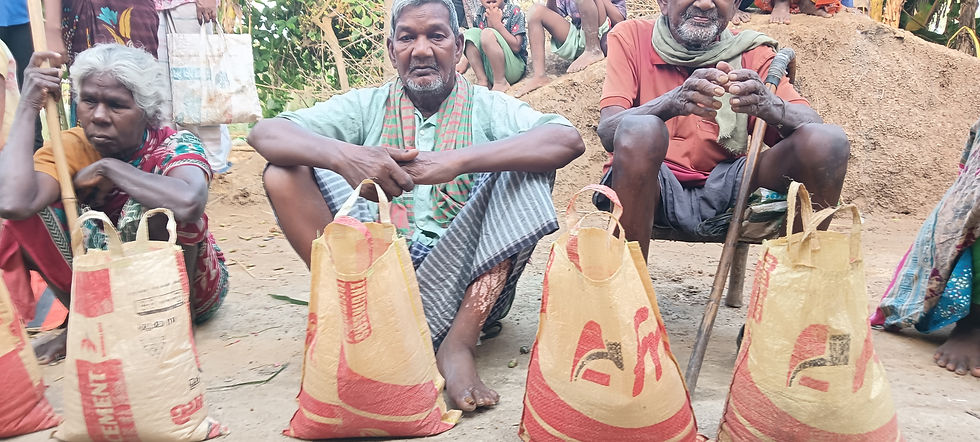
Your Generous Help Allows Lotus Ministry To Continue Effective Efforts
Support us directly through the founders' PayPal
One of the most distinctive elements of Lotus Ministry Trust's food strategy is how they balance cultural authenticity with nutritional effectiveness. Rather than distributing standardized aid packages designed elsewhere, they develop meal plans using traditional Bengali ingredients — mustard oil, red lentils, and green bananas — that communities already recognize, cook, and value.
Modern nutritional analysis informs the quantities and combinations, ensuring that protein, carbohydrate, and micronutrient targets are met. But the vehicle for that nutrition is always culturally familiar. This approach dramatically reduces food rejection rates and ensures that the meals actually get eaten — which is the entire point.
It also preserves something less tangible but equally important: dignity. Receiving a meal that looks and tastes like home communicates respect in a way that no amount of branding or messaging can replicate.
How Lotus Ministry Trust Selects Local Partners
Partner selection is where many humanitarian organizations lose the thread. Logistics capability, financial transparency, and organizational reach are the standard criteria — and they matter. But Lotus Ministry Trust adds a layer that most don't: cultural fluency.
Potential partners are evaluated on their existing relationships within the communities they serve, their understanding of local religious and social customs, and their track record of community-led problem solving. An NGO with excellent accounting practices but no genuine roots in a community will consistently underperform compared to a smaller, locally embedded organization that communities already trust.
Cultural Knowledge as a Core Criteria for Partnership
Lotus Ministry Trust evaluates every potential partner through a cultural competency lens before any operational discussion begins. This means asking specific questions: Does this organization know which villages have predominantly Hindu populations? Do their staff members understand the significance of Ramadan scheduling on food distribution timing?
Have they worked through local religious leaders before, and did those relationships hold? These aren't soft questions — they determine whether a partnership will produce real impact or just activity reports. For more insight, read about how Lotus Ministry Trust respects Bangladeshi culture and traditions.
Community Leaders With a Proven Track Record
The most valuable partners Lotus Ministry Trust has found aren't always the largest or best-funded local NGOs. Often, they're smaller organizations led by people who grew up in the communities they serve — individuals who know which elder to consult before a program launches, which neighborhoods have inter-community tensions that could affect distribution, and which communication styles actually land with local families. That embedded knowledge is irreplaceable, and Lotus Ministry Trust treats it as such.
Cultural Sensitivity During Crisis Response
Crisis response is where cultural strategy gets tested hardest. Floods, cyclones, and food shortages create pressure to move fast — and speed is necessary. But speed without cultural awareness produces the kinds of aid delivery failures that set back community trust for years. Lotus Ministry Trust has developed protocols that allow them to act quickly while maintaining the cultural standards that make their programs effective.
Why Speed Without Sensitivity Fails Communities
When disaster strikes, outside organizations often default to mass distribution models — trucks, megaphones, open queues. In Bangladesh, this approach creates immediate problems. Mixed-gender queues in conservative Muslim communities can cause families to avoid the distribution entirely, leaving the most vulnerable — women and children — without aid. Distributing food without halal certification in Muslim-majority crisis zones signals carelessness that communities remember long after the emergency passes.
The cost isn't just cultural — it's operational. Organizations that ignore these dynamics find themselves with food left undistributed, communities that won't engage with follow-up programs, and local partners who quietly distance themselves to protect their own community relationships.
Culturally Appropriate Food Distribution Practices
Lotus Ministry Trust's crisis response model includes several non-negotiable cultural standards, regardless of how acute the emergency is:
Gender-separated distribution lines in communities where mixed queues would deter participation from women
Halal-certified food packages distributed in Muslim-majority areas without exception
Community leader notification before distribution begins, even in fast-moving emergencies
Vegetarian-only packages prepared and clearly marked for Hindu communities
Distribution timing adjusted to avoid Friday prayer times and major religious observances
These aren't bureaucratic checkboxes. Each one directly affects whether aid reaches the people who need it most — or sits in a truck while a community stays home.
How International Supporters Can Engage Respectfully
International supporters — whether donors, volunteers, or partner organizations — often arrive in Bangladesh with genuine goodwill and limited cultural preparation. Good intentions don't prevent cultural missteps, and in Bangladesh, missteps have real consequences for the communities organizations are trying to help. Preparation is the bridge between wanting to help and actually helping.
Cultural Orientation Programs for Foreign Volunteers
Lotus Ministry Trust offers structured cultural orientation for international volunteers before they engage with communities. These programs go well beyond surface-level etiquette guides. Volunteers learn the social hierarchy within Bangladeshi villages, how to communicate respect to elders, why direct eye contact norms differ by gender and context, and how to navigate invitations to share tea or meals — which carry significant social meaning — without causing offense through refusal or inappropriate acceptance.
The orientation also covers the practical realities of working across religious communities in close proximity. A volunteer working in a district with both Muslim and Hindu villages needs to understand that the communication approaches, appropriate dress, and even the physical positioning during conversations may shift significantly from one community to the next.
Perhaps most importantly, volunteers learn the single most damaging assumption they can bring into the field: that their presence alone is helpful. Lotus Ministry Trust trains volunteers to understand that culturally uninformed engagement can undermine months of relationship-building that local staff have invested in a community.
Small Gestures That Open Doors: Bangla Greetings, Dress, and Holidays
Learning even a few words of Bangla — Assalamu Alaikum in Muslim communities, Namaskar in Hindu communities — signals to residents that an outsider has made an effort to meet them on their terms. This single gesture consistently generates warmer reception and greater cooperation than any amount of organizational branding. Dress matters equally: modest clothing that covers arms and legs in both Muslim and Hindu community contexts communicates awareness and respect without a word being spoken.
What to Ask Before Donating to Humanitarian Organizations in Bangladesh
Donors who want their contributions to land with genuine cultural respect have every right to ask direct questions before committing funds. The answers reveal whether an organization is truly embedded in the communities it serves or operating on assumptions from the outside.
Key questions worth asking any organization working in Bangladesh include:
Do your food relief programs distinguish between Muslim, Hindu, and Buddhist community dietary requirements?
Are your local partners selected based on community trust and cultural knowledge, or primarily on logistical capacity?
How do you handle distribution scheduling around Ramadan, Durga Puja, and other major religious observances?
Do international volunteers receive cultural orientation before engaging with communities?
Can you provide examples of how community leaders have shaped your program design?
Lotus Ministry Trust's Expansion Plans and Future Goals

Volunteer To Help These Volunteers
Support us directly through the founders' PayPal
Lotus Ministry Trust's current work is concentrated in northern Bangladesh, where food insecurity and cultural complexity intersect in ways that demand exactly the kind of nuanced approach they've developed. But the framework they've built — community-first partner selection, culturally adapted food programs, and religious sensitivity built into crisis response — is designed to scale. Their expansion strategy prioritizes replication of the model over rapid geographic spread, ensuring that cultural integrity isn't sacrificed for organizational growth.
Upcoming initiatives include educational workshops on Bangladeshi cultural practices aimed at both international supporters and partner organizations entering new regions. These workshops are designed to compress the learning curve for new partners, sharing the community relationship knowledge that Lotus Ministry Trust has accumulated over years of field experience. The goal is straightforward: more communities served, with the same depth of cultural respect that has made their existing programs work.
Scaling Cultural Respect Programs to Reach More Communities
Scaling any humanitarian program risks diluting what made it work in the first place. For Lotus Ministry Trust, the solution is deliberate: expand the model, not just the footprint. Rather than rushing into new districts with the same generic distribution approach that larger organizations default to, they replicate the relationship-building process that anchors their existing programs — starting with community mapping, local partner vetting, and religious needs assessment before a single resource is deployed.
The target is to reach additional communities across northern and central Bangladesh while maintaining the same granular cultural awareness that has defined their work so far. This means slower expansion by design — and measurably better outcomes as a result.
Community mapping first: Every new area receives a cultural and religious needs assessment before program design begins
Local partner prioritization: Expansion only proceeds where culturally fluent local partners are already present or can be identified
Phased rollout: New communities are brought into programs gradually, allowing trust to build before scale increases
Feedback loops: Community leaders are consulted at every phase, not just at launch
This approach takes longer than a top-down distribution model. But the communities Lotus Ministry Trust serves aren't statistics to be reached — they're people whose trust, once lost, is extraordinarily difficult to rebuild.
The strategy also protects Lotus Ministry Trust's existing community relationships. Rapid, poorly planned expansion in surrounding areas can create tension and competition that ripples back into areas where programs are already running well. Measured growth prevents that entirely.
Educational Workshops on Bangladeshi Cultural Practices
Lotus Ministry Trust is developing a series of educational workshops aimed at both incoming volunteers and partner organizations that are new to operating in Bangladesh. These workshops cover the cultural frameworks that inform daily life across Muslim, Hindu, Christian, and Buddhist communities — not as academic content, but as practical field preparation. Topics include appropriate communication styles with community elders, gender dynamics in aid distribution, religious calendar awareness, and the social significance of food sharing in Bengali culture. The goal is to dramatically shorten the learning curve for anyone entering the field while preserving the depth of cultural respect that Lotus Ministry Trust has built its reputation on.
Cultural Respect Is the Strategy, Not an Add-On
The most important insight from Lotus Ministry Trust's work isn't a specific program or technique — it's the fundamental reframing of what humanitarian strategy actually means. Cultural respect isn't something you layer on top of a logistics plan. It is the plan. When communities feel seen, their participation rates rise, their trust extends to future programs, and the impact of every resource deployed multiplies significantly.
Culturally appropriate meals see dramatically higher consumption rates than standardized aid packages
Community leader endorsement — earned through genuine cultural engagement — reduces distribution friction and increases reach
Religious sensitivity in scheduling ensures programs actually run when communities can participate
Gender-aware distribution models ensure the most vulnerable recipients — often women and children — aren't excluded by culturally blind logistics
Long-term trust built through cultural respect creates the access organizations need to sustain programs through future crises
Every one of these outcomes is a direct result of treating culture as operational infrastructure rather than a soft consideration. Organizations that skip this step aren't just being insensitive — they're leaving measurable impact on the table.
The broader lesson from Lotus Ministry Trust's model applies well beyond Bangladesh. Any humanitarian organization working across cultural boundaries — whether in South Asia, Sub-Saharan Africa, or the Middle East — faces the same fundamental challenge: the gap between good intentions and genuine impact is almost always a cultural gap. The organizations that close that gap consistently outperform those that don't, in every metric that matters.
Bangladesh is one of the most complex cultural environments in the world for humanitarian work, precisely because its diversity is often underestimated. Lotus Ministry Trust has turned that complexity into a competitive advantage — building programs that work because of their cultural specificity, not in spite of it. That's the model worth paying attention to.
Frequently Asked Questions
The following questions address the most common points of curiosity from donors, volunteers, and partner organizations exploring Lotus Ministry Trust's approach to culturally integrated humanitarian aid in Bangladesh.
Each answer draws directly from Lotus Ministry Trust's operational approach and the cultural realities of the communities they serve.
Does Lotus Ministry Trust Plan to Expand Beyond Bangladesh?
Lotus Ministry Trust's current focus remains firmly on Bangladesh, where the depth of community relationships and cultural knowledge they've developed over years of field work represents an irreplaceable operational asset. Expansion beyond Bangladesh would require rebuilding that foundation from scratch in an entirely different cultural context — a process that cannot be rushed without compromising the integrity of the model. For now, geographic expansion within Bangladesh, particularly into central districts, is the priority.
How Does Lotus Ministry Trust Balance Modern Aid With Traditional Values?
Modern nutritional science informs the composition of every meal program Lotus Ministry Trust runs — ensuring protein, carbohydrate, and micronutrient targets are met for the populations they serve. But the delivery vehicle is always culturally familiar: traditional Bengali ingredients like red lentils, mustard oil, seasonal vegetables, and locally recognized grains. The two aren't in conflict. Science determines the nutritional outcome; culture determines the form it takes. Both are non-negotiable.
What Types of Traditional Meals Are Included in Their Programs?
Lotus Ministry Trust's food relief programs center on meals that Bangladeshi families already prepare at home — dishes like khichuri (a rice and lentil preparation that carries deep cultural significance, particularly during floods and religious observances), dal-bhat (lentils with rice), and vegetable curries built around seasonal local produce. In Hindu communities, fully vegetarian meal sets are standard. In Muslim communities, all food is halal-certified. These aren't substitutions or compromises — they're the actual food traditions of the communities being served.
How Does Lotus Ministry Trust Handle Cultural Differences During Emergencies?
Emergency response protocols at Lotus Ministry Trust are pre-built with cultural standards embedded — not added after the fact. Gender-separated distribution lines, halal certification, community leader notification, and religious calendar awareness are all maintained even under crisis conditions. The reasoning is straightforward: an emergency is the worst possible time to damage community trust, because that trust is the access point for every follow-up program that the community will need in the weeks and months after a disaster.
Can International Donors Ensure Their Contributions Are Used in Culturally Sensitive Ways?
Yes — and asking directly is the most effective way to do it. Donors should feel confident asking organizations exactly how their programs account for the religious and cultural diversity of the communities they serve. Vague answers or generic commitments to "respecting local culture" are a red flag. Specific answers — referencing halal certification, vegetarian options, community leader engagement protocols, and religious calendar scheduling — indicate an organization that has actually built cultural respect into its operations.
Lotus Ministry Trust welcomes these questions because their operational model is built to answer them with specifics. Every program they run can be traced back to a cultural decision — a meal choice, a partner selection, a distribution format — that reflects genuine community knowledge rather than organizational assumption.





Comments