
Lotus Ministry Trust Kichri Meal Distribution Volunteer Stories & Experiences
- Jeffrey Dunan
- Apr 23
- 14 min read

Lotus Ministry Trust's kichri meal distributions are changing lives in rural Bangladesh — and the volunteers who show up are changed just as deeply.
Kichri, a simple dish of rice and lentils, is the cornerstone of Lotus Ministry's food relief program, chosen for its nutrition, affordability, and cultural familiarity.
88% of every donation goes directly to program activities, meaning your contribution reaches a family's bowl — not an administrative budget.
Volunteers don't need prior experience to join a distribution — what they gain in return is something no resume can capture.
Keep reading to discover what actually happens when a volunteer hands a child their first hot meal — and why that moment stays with them forever.
Help Change Lives In Bangladesh
Some experiences don't just move you — they rewire you entirely, and that's exactly what volunteers say about serving kichri meals with Lotus Ministry Trust in Bangladesh.
Lotus Ministry Trust has been on the ground since 2021, building food relief operations through direct community engagement in some of Bangladesh's most underserved rural villages. Their kichri meal program isn't just about feeding people — it's a carefully structured system that combines immediate nutrition with long-term community development. For volunteers who show up to serve, it becomes one of the most defining experiences of their lives.
What Volunteers Actually Experience at Lotus Ministry Trust Kichri Meal Distributions
Walking into a Lotus Ministry kichri distribution for the first time is disorienting in the best possible way. Volunteers often describe expecting chaos and finding instead something that resembles a community celebration — organized, dignified, and filled with an energy that's hard to put into words. The logistics are tight, the oversight is real, and yet the human warmth running through every distribution is unmistakable.
What surprises most first-time volunteers isn't the scale of need — it's the resilience and grace of the people they're serving. Families who have walked long distances, who have been waiting patiently, who greet volunteers with a quiet gratitude that cuts straight through any preconceptions a newcomer might carry. It recalibrates everything.
"When we see children who once received our meals now graduating from high school, or families who once depended on our relief now helping their neighbors — that's when we know we've made a lasting difference."— Lotus Ministry Trust Field Coordinator
Why Kichri Is the Meal at the Heart of the Program
Kichri is a traditional South Asian dish made from rice and lentils, cooked together into a soft, hearty, easily digestible meal. It's deeply familiar to Bangladeshi families, culturally appropriate, and nutritionally dense enough to make a real difference for children and adults facing food insecurity. For Lotus Ministry Trust, it isn't just a practical choice — it's a respectful one.
The dish can be prepared at scale without sacrificing nutritional value, and its core ingredients are sourced locally wherever possible, supporting regional suppliers while keeping costs down. That efficiency is part of why Lotus Ministry is able to direct 88% of all donations directly to program activities, with administrative costs held below 12% of total expenditures.
Who Volunteers Are Serving on the Ground in Bangladesh
The communities receiving kichri distributions through Lotus Ministry Trust are predominantly rural families caught in cycles of poverty that are difficult to break without outside support. Among those served are mothers like Fatima, who watched her children grow weaker during a particularly harsh season before Lotus Ministry volunteers arrived with meals and, eventually, skills training that changed her family's trajectory permanently. These aren't abstract statistics — they are specific people with names, histories, and futures that volunteers become a part of simply by showing up.
The Emotional Reality of Handing Someone Their First Hot Meal

Help Our Volunteers Change Lives In Bangladesh
No training prepares a volunteer for the weight of that first handoff. The moment a bowl of warm kichri passes from your hands to someone else's — someone who needed it, who has been waiting, who receives it with a gratitude so genuine it has no performance in it — something shifts. Volunteers across backgrounds and experience levels describe this moment in almost identical terms: quiet, enormous, and permanent.
The emotional landscape of a distribution isn't one-dimensional. Volunteers report feeling joy, grief, humility, and purpose all at once — sometimes within the span of a single hour. That complexity is part of what makes the experience so formative. It doesn't offer easy answers. It offers something better: honest contact with a reality larger than your own daily concerns.
Volunteers frequently describe a heightened sense of gratitude for things previously taken for granted
Many report that witnessing resilience firsthand challenges assumptions about poverty and helplessness
The act of physical service — stirring, ladling, handing — grounds abstract compassion in something real and embodied
Connections formed during distributions often extend well beyond the volunteer's time in the field
What Lotus Ministry Trust has understood from the beginning is that aid delivered with dignity lands differently than aid delivered with pity. Volunteers are trained — explicitly and by example — to show up as partners in a community moment, not as outsiders dispensing charity. That framing changes everything about how the interaction feels, for everyone involved.
The Moment That Changes Every Volunteer
Ask any Lotus Ministry volunteer about their defining memory and the answer almost always involves a specific face, a specific pair of hands accepting a bowl, or a specific child's expression shifting from wariness to something open and trusting. It's always particular. That particularity — the fact that it wasn't an abstract act of giving but a real exchange between two real people — is what embeds itself so deeply.
How Volunteers Describe the Silence Before a Distribution Begins
In the minutes before a distribution begins, there is a stillness that experienced volunteers say is unlike anything else. The community has gathered. The food is ready. Community leaders have completed their verification process. And for a brief moment, everyone — volunteers and recipients alike — seems to hold their breath together. Several volunteers have described this silence as the most spiritually significant moment of their entire trip.
Why Children's Reactions Leave the Deepest Impression
Children don't filter their responses, and that unguarded honesty is what stays with volunteers longest. A child receiving kichri might eat with a focus and seriousness that no adult in a food-secure environment ever brings to a meal. That image — a small person treating a bowl of rice and lentils with the full weight of their attention — has a way of restructuring a volunteer's relationship to abundance, waste, and gratitude in ways that persist long after they return home.
What a Typical Kichri Distribution Day Looks Like
Lotus Ministry Trust distributions don't happen by accident — they are the result of careful pre-coordination with local community leaders, transparent public announcements to ensure fair access, and a structured day-of process that keeps things dignified and efficient. For new volunteers, understanding the flow helps them contribute meaningfully from the first hour.
1. Arrival and Community Gathering
Volunteers typically arrive at distribution sites in the early morning, well before the community gathers. This early window is used to coordinate with local leaders, confirm the verified recipient list, and set up the cooking and serving stations. The atmosphere during setup carries a focused, purposeful energy — everyone knows what needs to happen and why it matters.
As community members begin to arrive, the gathering takes on a character that surprises most first-time volunteers. There is order without rigidity, anticipation without desperation. Local leaders play a central role in guiding the flow of people, ensuring that the process feels community-owned rather than externally imposed. For volunteers, this is the first lesson: you are here to support something that already belongs to these people.
2. Meal Preparation With Local Ingredients
Kichri preparation at scale is both a logistical operation and a communal act. Large quantities of rice and lentils are cooked together, often with locally sourced spices and vegetables that add nutritional value and reflect regional flavor preferences. Volunteers work alongside local staff and community members during this stage, which immediately breaks down the distance between "helper" and "helped."
Sourcing ingredients locally is a deliberate choice by Lotus Ministry Trust. It keeps costs manageable — contributing directly to that 88% program expenditure ratio — while simultaneously injecting money into the local economy. Even the act of buying lentils from a nearby supplier is part of a broader philosophy: every decision should strengthen the community, not create dependency on external systems.
3. Distribution With Community Leader Oversight
"All food relief distributions are publicly announced and conducted with local community leader oversight. Detailed recipient lists with verification ensure that aid reaches those who need it most — not those who simply show up first."— Lotus Ministry Trust Accountability Framework
The distribution itself is structured around verified recipient lists compiled in advance with community leader input. This isn't bureaucracy for its own sake — it's the mechanism that ensures fairness and prevents the kind of aid diversion that undermines trust in relief programs. Every person who receives a meal has been identified and verified before distribution day begins.
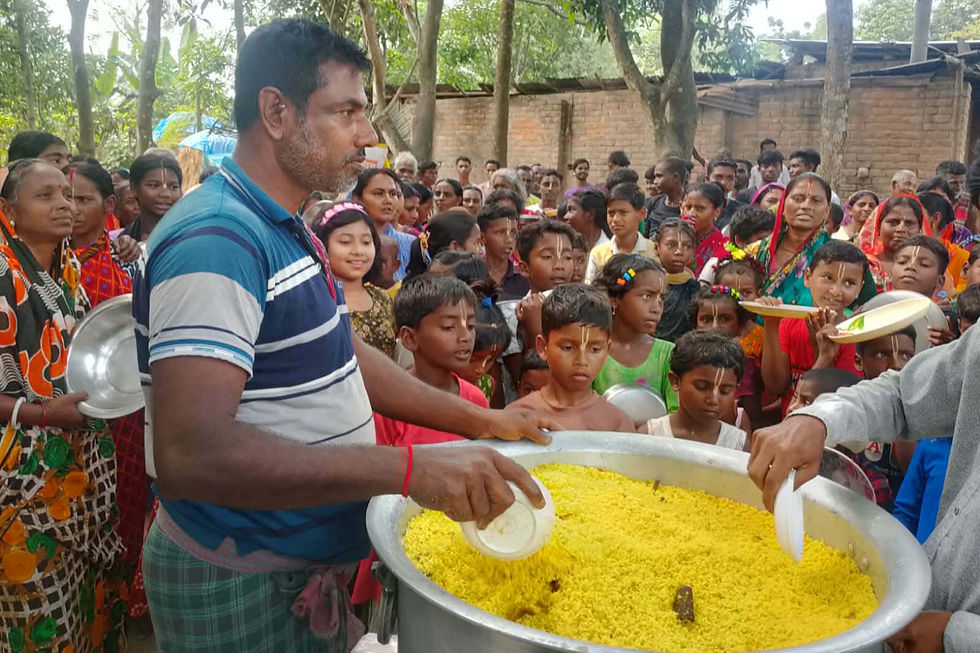
Volunteers serve directly at the distribution points, ladling kichri into bowls or containers that recipients bring from home. That detail — recipients bringing their own containers — is worth noting. It's a design choice that preserves dignity, signals that this is a community event rather than an emergency handout, and reinforces the partnership dynamic that Lotus Ministry Trust builds all of its programming around.
Community leaders remain present and actively involved throughout distribution. Their oversight isn't ceremonial — they are accountable for the process, and their community standing is tied to its integrity. This layered accountability structure is one reason Lotus Ministry Trust has maintained the trust of the villages it serves since launching its Bangladesh operations in 2021.
4. Follow-Up Needs Assessment After Feeding
Once distribution is complete, Lotus Ministry staff and trained volunteers conduct brief needs assessments with families in attendance. These conversations gather information about household vulnerabilities, educational access, skills training interest, and other factors that inform the organization's longer-term programming decisions. A single distribution day thus generates data that shapes months of future planning — turning a meal into the beginning of a sustained relationship with each community.
How Volunteering With Lotus Ministry Trust Changes You
There's a reason Lotus Ministry Trust volunteers return. Not just once — many come back multiple times, and a significant number transition from short-term participants into long-term supporters, donors, and advocates. The experience of serving kichri meals in a rural Bangladeshi village doesn't stay neatly in the past. It follows you home, quietly rearranging your priorities and expanding your sense of what a meaningful life can look like.
Shifts in Perspective Volunteers Report After Their First Trip
The perspective shifts volunteers describe aren't vague feelings of being "grateful for what you have." They are specific, structural changes in how people understand poverty, resilience, community, and their own place in a global picture. Volunteers who arrived thinking they were coming to give something almost universally report leaving with the sense that they received far more than they offered. That inversion — realizing the exchange was mutual — is what tends to be most transformative.
The Relationships Built Between Volunteers and Families
Relationships formed during Lotus Ministry distributions often defy the short duration of the volunteer's stay. There is something about sharing food — preparing it together, serving it, watching someone eat something you helped make — that accelerates human connection in ways that weeks of other interaction might not. Volunteers and families communicate across language barriers through expression, gesture, and the universal language of a meal shared with intention.
Volunteer Experience Stage | What Volunteers Typically Feel | Long-Term Impact Reported |
Arrival & Setup | Nervous energy, anticipation, adjustment | Increased cultural awareness and adaptability |
Meal Preparation | Grounded, purposeful, connected to local community | Deeper appreciation for food and communal labor |
Distribution | Overwhelmed, humbled, fully present | Permanent shift in understanding of poverty and resilience |
Needs Assessment | Curious, empathetic, motivated to do more | Increased likelihood of ongoing advocacy or donation |
Departure | Emotionally full, reflective, changed | Lasting personal reorientation of values and priorities |
Many volunteers maintain contact with Lotus Ministry Trust staff after returning home, following the progress of communities they served and contributing financially to programs they now understand from the inside. This transition from volunteer to sustained supporter is not incidental — it's the natural result of building genuine relationships rather than transactional aid encounters.
For some, the relationship doesn't stop at personal connection. Skilled professionals — nutritionists, educators, logistics specialists, social workers — often find that their expertise is directly applicable to Lotus Ministry's programming needs. Skills-based volunteering allows these individuals to contribute in ways that go beyond a single distribution day, developing training materials, conducting community assessments, or building organizational capacity that outlasts any one visit.
How Lotus Ministry Trust Keeps Distributions Honest and Accountable
Help Our Volunteers Bring Food Aid
Trust is the currency that makes aid work — without it, communities disengage, donors look elsewhere, and programs collapse. Lotus Ministry Trust has built its entire operational model around earning and maintaining that trust, both with the communities it serves and with the donors and volunteers who make the work possible. The accountability measures embedded in every distribution aren't a compliance exercise — they are a statement of values.
Verified Recipient Lists and Community Leader Oversight
Every Lotus Ministry distribution operates from a verified recipient list developed in collaboration with local community leaders before distribution day. These lists identify households based on need criteria established through community consultation — not external assumptions — and are reviewed and confirmed by leaders whose own accountability to their neighbors ensures the process stays honest. Public announcements of upcoming distributions further reinforce transparency, giving community members the information they need to raise concerns if the process goes off track.
Administrative Costs Below 12% of Total Expenditures
Lotus Ministry Trust maintains a financial efficiency standard that puts most charitable organizations to shame: 88% of every donation goes directly to program activities, holding administrative costs firmly below 12% of total expenditures. That figure covers food procurement, distribution logistics, educational materials, and community development initiatives — the full operational breadth of what Lotus Ministry does on the ground. For donors who have watched other organizations absorb contributions into overhead, this ratio is a meaningful differentiator.
Photographic Documentation and Donor Reporting
Every distribution generates photographic documentation that forms the basis of transparent donor reporting. Volunteers who participate in distributions often become part of this record themselves — serving, cooking, and engaging with community members in images that tell the story of exactly where resources went and who they reached. This visual accountability closes the loop between a donor's contribution and its real-world impact in a way that financial reports alone cannot.
Lotus Ministry Trust treats documentation not as an afterthought but as a core operational responsibility. The photographic record of each distribution serves multiple functions simultaneously: it verifies that aid reached verified recipients, it provides communities with a record of the support they received, and it gives donors and volunteers a window into outcomes that written summaries can only approximate. Transparency here isn't a policy — it's a practice built into every distribution day.
Distribution sites are photographed before, during, and after each event to capture the full scope of operations
Recipient interactions are documented with community consent, preserving dignity throughout the process
Photographic reports are made available to donors who request them, connecting contributions to specific distributions
Field coordinators maintain running documentation used in internal reviews and program refinement
What this level of documentation ultimately communicates is that Lotus Ministry Trust has nothing to hide and everything to show. For volunteers considering their first trip, and donors deciding where to send their next contribution, that openness is one of the most compelling things the organization offers.
Ways to Get Involved Beyond Showing Up in Person
Physical presence at a kichri distribution is one way to engage with Lotus Ministry Trust's work — but it's far from the only one. The organization actively welcomes diverse forms of involvement because it understands that sustainable impact requires a wide base of support, not just a rotating pool of on-site volunteers. Whether you have a week, a skill set, or simply a willingness to give financially, there is a meaningful role for you.
Skills-based volunteering is one of the most underutilized but highest-impact options available. Professionals in nutrition, education, logistics, social work, communications, and community development can contribute expertise that directly strengthens Lotus Ministry's programming.
Developing training materials, conducting remote needs assessments, or building organizational systems that improve distribution efficiency — these contributions don't require a plane ticket, but they leave a lasting imprint on how the organization operates.
Financial contributions remain the most scalable form of support. Given Lotus Ministry's 88% program expenditure rate, even modest donations translate directly into meals served, educational resources delivered, and community assessments conducted. For those who want to bridge the gap between financial giving and personal involvement, becoming an advocate — sharing Lotus Ministry's work within your own networks — multiplies the reach of every dollar donated and every story shared. You can support Lotus Ministry Trust directly here and put your contribution to work immediately.
Frequently Asked Questions
If you're considering volunteering with Lotus Ministry Trust or supporting their kichri meal distributions, chances are you have specific questions about how it all works. Here are honest, detailed answers to the questions people ask most.
What Exactly Is Kichri and Why Does Lotus Ministry Trust Use It?
Kichri is a traditional South Asian dish made by cooking rice and lentils together, typically with spices and sometimes vegetables. It's been a staple of Bengali cuisine for centuries and is deeply familiar to the communities Lotus Ministry Trust serves. The dish is soft, easy to digest, and nutritionally complete enough to provide meaningful sustenance to children and adults experiencing food insecurity.
Lotus Ministry chose kichri for reasons that go beyond convenience. It's a culturally resonant choice — receiving kichri doesn't feel like receiving foreign aid, it feels like receiving something that belongs to the community's own culinary identity. That distinction matters enormously for the dignity of the people being served and for the long-term trust between Lotus Ministry and the villages it works in.
Why kichri works so well as a relief meal:
Nutritionally complete — rice and lentils together provide carbohydrates, protein, and essential micronutrients Culturally familiar — deeply rooted in Bengali food tradition, received with comfort rather than unfamiliarity Cost-effective at scale — core ingredients are affordable and locally sourceable, maximizing the reach of each donation Easy to prepare in large quantities — distribution logistics are manageable even in remote locations with limited infrastructure Digestively accessible — suitable for children, the elderly, and individuals with compromised health
The decision to anchor an entire food relief program around a single, culturally grounded dish reflects Lotus Ministry's broader philosophy: solutions should come from within communities, not be imposed upon them from outside.
Do Volunteers Need Prior Experience to Join a Distribution?
No prior experience is required to volunteer with Lotus Ministry Trust at a kichri distribution. The organization welcomes volunteers across a wide range of backgrounds, skills, and availability levels. What matters far more than experience is a genuine willingness to show up fully, follow the lead of local community leaders and Lotus Ministry staff, and engage with the work — and the people — with respect and humility. First-time volunteers are integrated into distribution teams where they can contribute immediately while learning the process organically from those around them.
Can International Volunteers Participate in Kichri Distributions in Bangladesh?
International volunteers are welcomed by Lotus Ministry Trust, and the organization accommodates participants with varying time commitments and areas of expertise. Short-term on-site volunteers can join specific distribution events, contribute to community assessments, or participate in educational workshops running alongside food relief programming. Longer-term volunteers or those with specialized skills can engage in more structured roles that deepen their contribution over time.
That said, Lotus Ministry Trust is clear that effective international volunteering requires more than physical presence — it requires a genuine orientation toward learning from and supporting local staff and community leaders rather than leading from the front. International volunteers who arrive with that mindset consistently report the most meaningful experiences, both for themselves and for the communities they serve.
Short-term volunteers can participate in specific distribution events without long-term commitment
Skills-based international volunteers can contribute remotely or on-site depending on their area of expertise
All international volunteers work within structures led by local Lotus Ministry staff and community leaders
Lotus Ministry Trust coordinates logistics support to help international participants navigate field conditions in rural Bangladesh
The presence of international volunteers also serves a secondary function that Lotus Ministry Trust values: it builds a global network of informed advocates who carry the stories of these communities back to their home countries, expanding awareness and donor support in ways that local operations alone cannot achieve.
How Do I Know My Donation Directly Funds a Kichri Meal Distribution?
If you want to see where your support goes, Lotus Ministry Trust's success stories provide exactly that — real accounts of real families whose lives shifted because a meal arrived, a volunteer showed up, and a community was treated with the dignity it deserved. Lotus Ministry Trust continues to expand its reach across rural Bangladesh, and whether you give your time, your skills, or your financial support, you become part of that story.











Comments