
Bhagavad Gita Teaching & Lotus Ministry Trust Student Spotlight Feature

Key Takeaways
Rahul's transformation through Bhagavad Gita teachings demonstrates how ancient wisdom can provide practical solutions to modern challenges in rural communities
Lotus Ministry Trust's innovative educational approach combines spiritual teachings with academic support, creating holistic development for village students
Students in rural Bangladesh are overcoming significant socioeconomic barriers through value-based education that emphasizes personal responsibility and community service
Practical application of Gita teachings helps students develop resilience, improved study habits, and conflict resolution skills applicable to daily village life
The ripple effect of one student's transformation can positively impact entire families and communities, creating sustainable change in rural Bangladesh
Change often begins with a single story. In the remote villages of northern Bangladesh, one student's journey illuminates how ancient wisdom can transform modern lives and entire communities.
Meet Rahul: How the Bhagavad Gita Teachings Changed a Village Boy's Life
At sixteen, Rahul Kumar stands tall among his peers—not just in physical stature but in the quiet confidence that radiates from him. Three years ago, you wouldn't have recognized this same boy: head down, struggling with basic literacy, and rapidly losing hope in his educational future. Today, he leads a youth study circle, helps younger students with their homework, and has become what village elders call "a beacon of possibility" in their small community. The catalyst for this remarkable transformation? His enrollment in Lotus Ministry Trust's Bhagavad Gita education program, where ancient teachings provided modern solutions to the challenges of rural life.
From Rural Struggles to Spiritual Awakening
"Before I understood the Gita's teachings, I saw only problems everywhere," Rahul explains, his eyes reflecting a wisdom beyond his years. "Now I see opportunities to apply what I've learned—to find purpose even in difficulties."
Growing Up in Northern Bangladesh's Remote Village
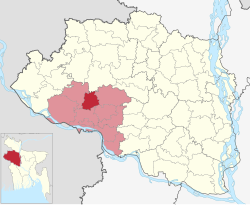
"Mohanpur Upazila - Wikipedia" from en.wikipedia.org
Help Lotus Ministry Provide Educational Opportunities In Bangladesh
Nestled between verdant rice paddies and flood-prone lowlands, Rahul's village of Mohanpur represents both the beauty and challenges of rural Bangladesh. Electricity remains intermittent at best, with many homes still lacking basic infrastructure. Children typically divide their time between academic studies and helping with family livelihoods—farming, or small crafts that bring modest income. For Rahul, early mornings began with helping his father before rushing to school, often arriving late and exhausted.
The village's remoteness created educational isolation. Government schools existed but suffered from teacher absenteeism and outdated resources. Many children, particularly boys, dropped out by age fourteen to work full-time supporting their families. Girls often faced even greater barriers, with cultural pressures toward early marriage limiting their educational opportunities.
60% of village children discontinued education before secondary completion
Average family income hovered around 12,000 taka monthly (approximately $140 USD)
Most homes lacked study spaces and reliable lighting for evening homework
Cultural traditions often prioritize immediate economic contribution over long-term educational investment
Early Educational Challenges and Family Hardships
For Rahul, these village realities translated into specific daily struggles. His family's bamboo and tin home housed seven people in two small rooms, making quiet study nearly impossible. His father's income fluctuated seasonally, creating periods where school supplies became luxury items. Most challenging was the cycle of discouragement: falling behind in class led to embarrassment, which led to avoidance, which deepened academic gaps.
"I almost gave up on school entirely," Rahul admits. "My marks were poor, and I couldn't see how studying would change anything in our situation. My father needed help, and I thought my time would be better spent learning his craft."
These circumstances reflect the reality for thousands of Bangladeshi rural students—caught between immediate survival needs and the longer-term promise of education. Without intervention, Rahul's story might have become yet another statistic of educational attrition.
The First Encounter with Lotus Ministry Trust
The turning point came when Lotus Ministry Trust established an afternoon program in Mohanpur's community center. Curiosity initially drew Rahul to attend. "They announced they would teach something called the Bhagavad Gita, which I had never heard of," he recalls with a smile. "But they also promised to help with regular school subjects. My mother encouraged me to try it, thinking at minimum it might improve my grades."
"Bringing the Bhagavad Gita into our lessons has inspired many children to pursue higher goals and care for their community." – Anisul Haque, Village Teacher
What Rahul couldn't anticipate was how profoundly this ancient text would speak to his modern challenges. Lotus Ministry Trust's innovative approach combined practical academic support with spiritual wisdom, creating a holistic educational experience unlike anything previously available in Mohanpur. Three afternoons weekly, students gathered to learn both conventional subjects and timeless principles from the Gita.
Transformative Teachings of the Gita

Rahul's initial skepticism quickly transformed into genuine interest as he began exploring the Bhagavad Gita's teachings. The ancient dialogue between Krishna and Arjuna on the battlefield of Kurukshetra suddenly felt relevant to his daily struggles in rural Bangladesh. "I was surprised to find answers to questions I hadn't even formed yet," Rahul reflects. "Questions about purpose, about duty, about how to face disappointment."
Discovering Purpose Beyond Circumstances
For rural students like Rahul, one of the most profound realizations was that meaning and purpose exist independently of external circumstances. The Gita's emphasis on finding one's dharma (duty) and performing it with excellence resonated deeply with young people often discouraged by limited opportunities. "I learned that my worth isn't determined by my family's income or our village's resources," explains Rahul. "The Gita taught me that how I approach my work—whether studying, or helping others—matters more than what that work is." This perspective shift ignited newfound motivation among students who previously saw little point in academic pursuits.
Key Lessons That Resonated Most Deeply
"Karmanye vadhikaraste ma phaleshu kadachana" - these Sanskrit words from Chapter 2, Verse 47 became a mantra for Rahul and his peers. The teaching that one has the right to perform prescribed duties but not to the results revolutionized how students approached their studies and daily challenges. For young people accustomed to measuring worth through immediate outcomes, this wisdom provided liberation from the cycle of disappointment when results didn't match efforts.
Equally transformative was the Gita's teaching on equanimity—maintaining balance in success and failure, joy and sorrow. In a region where monsoon floods could destroy a season's crops overnight or where family illness could derail educational plans, learning to maintain mental steadiness proved invaluable. Students practiced applying these principles to everything from exam preparation to family conflicts.
"Since my child joined the rural Bangladesh Bhagavad Gita school, our entire family has grown stronger and wiser. The changes we see go far beyond academics." – Fatima Begum, Local Parent
How Ancient Wisdom Applies to Modern Village Life
The brilliance of Lotus Ministry Trust's approach lies in connecting philosophical concepts to practical village realities. Students don't just memorize verses; they workshop real-life applications. When discussing Krishna's instruction to Arjuna about selfless action, students brainstorm ways this applies to community challenges like water access or educational equity. Teachers guide discussions about how the principle of non-attachment can help families weather crop failures or economic setbacks.
For Rahul, this practical spirituality transformed abstract concepts into living principles. "I realized the Gita wasn't just something to study but something to live," he says. "When our neighbor's cow trampled our garden, I remembered the teaching about controlling anger. When my younger sister needed help with schoolwork despite my own busy schedule, I recalled Krishna's words about selfless service."
The Teacher Who Made the Difference
Behind every educational transformation stands a dedicated teacher. For Rahul, that person was Priya Sharma, a Lotus Ministry Trust educator who combined subject matter expertise with genuine compassion. "Teacher Priya never just lectured us," Rahul explains. "She would share her own struggles with applying Gita principles and invite us to discuss ours." This vulnerability created a learning environment where students felt safe exploring difficult questions.
Priya introduced innovative teaching methods that accommodated different learning styles. Visual learners mapped key Gita concepts on colorful charts. Kinesthetic learners acted out dialogues between Krishna and Arjuna. Those who learned through discussion participated in daily reflection circles. This multisensory approach ensured that students like Rahul, who had previously struggled with traditional lecture-based instruction, could absorb and apply the teachings effectively.
Practical Impact on Daily Life
The true measure of education lies not in theoretical understanding but in transformed living. For Rahul and his fellow students, the Bhagavad Gita's teachings catalyzed remarkable changes across every dimension of daily life—from study habits to family dynamics to community engagement. As one village elder observed, "These children carry themselves differently now. There's a sense of purpose and responsibility we haven't seen before."
Academic Improvements and New Study Habits
Within six months of joining the program, Rahul's academic performance showed measurable improvement. His grades rose from barely passing to consistently scoring in the top quartile of his class. More significant than the numerical improvement was his fundamentally changed approach to learning. Drawing from the Gita's emphasis on discipline (tapas) and focused attention, Rahul developed structured study routines. He began waking an hour earlier to study in the quiet morning hours before helping his father. He organized study groups where students supported each other through difficult concepts.
The Gita's teaching that work itself is worship transformed mundane homework into meaningful practice. "I stopped seeing schoolwork as a burden and started viewing it as an opportunity to cultivate excellence," Rahul explains. This mental reframing proved powerful for rural students often questioning education's relevance to their daily realities. Teachers reported increased homework completion rates, improved class participation, and fewer absences among program participants.
Family Relationships Transformed
Perhaps the most surprising impact came in family dynamics. As Rahul began applying concepts like patience, selfless service, and mindful communication at home, tensions that had characterized family interactions began to shift. His mother noticed that he no longer argued about household responsibilities but completed them mindfully. His relationship with his younger siblings improved as he practiced listening more attentively and responding with greater thoughtfulness.
"The change in Rahul affected our entire household," his mother shares. "He began explaining Gita concepts at dinner, and soon we all found ourselves trying to practice them. When his father returned tired from working, Rahul would help silently instead of complaining about his own fatigue. This small change created a ripple effect of kindness throughout our home."
Handling Village Conflicts with Gita Principles
Rural village life inevitably brings conflicts—disputes over land boundaries, water access, or community resources. Traditionally, these tensions could simmer for generations. The students' application of Gita principles introduced new approaches to conflict resolution. Rahul describes mediating a dispute between his uncle and a neighbor over damage caused by wandering livestock. "Instead of taking sides, I remembered Krishna's teaching about seeing the divine in all beings. I helped them find a solution focused on repairing the relationship, not just the material damage."
When water access became contentious during a particularly dry season, Rahul and fellow students organized a village meeting using Gita-inspired dialogue techniques. They facilitated conversations about equitable resource sharing rather than competitive hoarding. The community developed a rotation system that ensured fair distribution while maintaining social harmony—a practical application of the Gita's teachings on balance and community welfare.
The Ripple Effect: Beyond One Student
Individual transformation inevitably creates wider change. Rahul's journey exemplifies how a single student's growth can catalyze community-wide transformation. What began as one boy's educational intervention has blossomed into a movement affecting hundreds of lives across multiple villages in northern Bangladesh.
The metrics tell part of the story: school attendance in Mohanpur has increased 37% since the Gita program began, dropout rates have decreased significantly, and teachers report improved classroom behavior. But the qualitative changes—renewed hope, strengthened community bonds, and cultural revitalization—tell an even more compelling narrative of rural renaissance.
Rahul's Family Members Join Gita Classes

Witnessing Rahul's transformation, his family members became curious about the source of these positive changes. His mother began attending the women's Gita study circle, finding particular resonance with teachings about inner peace amid external challenges. "As a woman in our village, I face many pressures," she explains. "Learning to find stillness within myself has changed how I respond to difficulties."
Rahul's younger siblings eagerly joined age-appropriate program activities, absorbing the values and practices that had so benefited their brother. His father, initially skeptical, became a vocal advocate after seeing how the teachings complemented rather than competed with family traditions. During evening meals, the family now discusses Gita concepts together, applying ancient wisdom to daily village challenges.
The intergenerational impact extends to Rahul's grandfather, who rediscovered connections to spiritual traditions he had practiced in his youth. "These teachings were part of our heritage that modern life had pushed aside," the elder reflects. "Through my grandson, I've reconnected with wisdom I had forgotten but deeply needed."
Neighboring Villages Request Similar Programs
News of Mohanpur's transformation spread quickly through the regional network of villages. Community leaders from neighboring Chandpur and Lakshmipur visited to observe the program, returning with requests for similar initiatives in their communities. Within eighteen months, Lotus Ministry Trust expanded to five additional villages, adapting their approach to respect each community's unique needs while maintaining core philosophical elements.
This organic growth created unexpected leadership opportunities for advanced students like Rahul. As new programs launched, experienced students served as peer mentors, strengthening their own understanding while supporting newcomers. "Teaching others has deepened my own practice," Rahul explains. "When I help someone understand a concept from the Gita, I discover new dimensions of meaning for myself."
The cross-village connections foster a broader sense of community beyond traditional village boundaries. Students from different locations collaborate on service projects, academic competitions, and cultural celebrations, creating networks that strengthen regional resilience and cooperation. These relationships have proven particularly valuable during natural disasters when village-to-village support systems facilitate more effective emergency response.
"The profound impact of the Bhagavad Gita curriculum can be seen in individual lives and in village-wide transformations. Parents and elders recount with pride how the once-neglected school children have become articulate, compassionate leaders who balance respect for tradition with innovative problem-solving." - Lotus Ministry Trust Annual Report
Your Role in Supporting More Success Stories
Lotus Ministry Trust continues expanding its transformative educational programs across rural Bangladesh, with each village producing success stories like Rahul's. Through sponsorship, volunteers, and advocacy, you can help write the next chapter of this remarkable educational movement that bridges ancient wisdom and modern rural development.
Frequently Asked Questions
Since launching the Bhagavad Gita educational initiative, Lotus Ministry Trust has received numerous inquiries from potential supporters, educators, and community advocates. Below, we address the most common questions to help you better understand the program's approach and impact.
These questions reflect the growing interest in holistic educational models that honor cultural traditions while preparing students for contemporary challenges. As the program continues to evolve, Lotus Ministry Trust remains committed to transparency and continuous improvement.
How does Lotus Ministry Trust select students for their programs?
Lotus Ministry Trust employs an inclusive approach rather than selective admission. Programs are open to all students in partner villages, with special outreach to those experiencing academic difficulties or socioeconomic challenges. Rather than choosing students based on prior achievement, the Trust focuses on identifying communities where need is greatest, then works with local leaders to ensure that all interested children can participate regardless of academic standing, religious background, or family circumstances.
What age groups can participate in the Bhagavad Gita schools?
The programs serve students from ages 6 to 18, with curriculum and teaching methods tailored to developmental stages. Younger children (6-9) engage primarily through stories, art, and simple value lessons derived from the Gita. Middle years students (10-13) begin exploring key concepts and verses with practical applications to daily life. Older students (14-18) undertake deeper philosophical study while developing leadership skills and community service projects.
Additionally, parent and elder programs run parallel to student activities, creating intergenerational learning communities that strengthen program impact and sustainability. These adult sessions focus on applying Gita wisdom to family relationships, community challenges, and personal growth.
Do students need prior religious knowledge to benefit from the program?
No prior knowledge is required or expected. The program presents Bhagavad Gita teachings as universal wisdom applicable across cultural and religious backgrounds. Teachers emphasize practical life skills, ethical principles, and personal development rather than religious doctrine. The diverse religious makeup of participating villages—including Hindu, Muslim, and Christian families—demonstrates how the program's philosophical approach transcends specific religious boundaries while respecting all faith traditions.
How can I sponsor a student like Rahul through Lotus Ministry Trust?
Student sponsorship begins at $25 monthly, covering educational materials, teacher support, nutritional supplements, and community program costs. Sponsors receive regular updates about their student's progress and the village program's development. Beyond individual sponsorship, supporters can fund specific village initiatives (starting at $250), contribute to teacher training programs ($500-$1000), or support infrastructure improvements like study centers and libraries.
Corporate and organizational partnerships also provide meaningful support through matched employee giving, in-kind donations of educational technology, and professional development opportunities for program graduates. The Trust's sustainable sponsorship model ensures continuous student support while working toward community self-sufficiency.
What percentage of donations goes directly to educational programs?
Lotus Ministry Trust maintains an exceptional 92% program-to-overhead ratio, with just 8% directed to essential administrative functions. This efficiency results from the Trust's community-based operational model, which leverages local resources and volunteer contributions. Financial transparency is maintained through annual third-party audits, with reports available to all donors upon request.
The Trust implements strategic sustainability planning for each village program, gradually transitioning from external funding to community support as local capacity develops. This approach ensures that donor contributions create lasting change rather than dependency, with most village programs achieving partial self-sufficiency within three to five years of inception.
Through careful stewardship of resources and community-centered program design, each contribution maximizes impact for students like Rahul while strengthening village educational infrastructure for generations to come. As the Trust's founder often notes, "We measure success not by how many students we serve today, but by how many communities can continue this work tomorrow."
Rahul's story represents just one of hundreds unfolding across rural Bangladesh as ancient wisdom meets modern educational needs. Through the Bhagavad Gita's timeless teachings, students are discovering inner resources, developing practical life skills, and building the resilience needed to transform not just their own futures but the futures of entire communities.









Comments